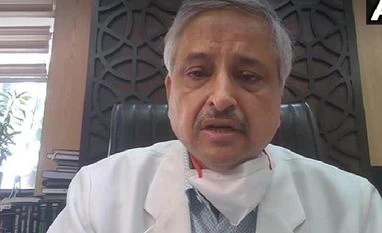
“It is a piece of misinformation that subsequent waves of the coronavirus pandemic are going to cause severe illness in children. There is no data - either from India or globally - to show that children will be seriously infected in subsequent waves,” said Dr Randeep Guleria.
Dr Guleria cited that 60 per cent to 70 per cent of the children who got infected and got admitted in hospitals during the second wave in India, had either comorbidities or low immunity; healthy children recovered with mild illness without need for hospitalisation.
Explaining why why waves occur in any pandemic. Dr Guleria said: "Waves normally occur in pandemics caused due to respiratory viruses; the 1918 Spanish Flu, H1N1 (swine) flu are examples. “The second wave of 1918 Spanish Flu was the biggest, after which there was a smaller third wave.”
Earlier in the day, VK Paul, a member for health in the Indian government’s think-tank NITI Aayog, also said there was no evidence to suggest that children will be more affected than adults in the third wave of the Covid-19 pandemic.
“It is uncertain that a wave would affect children specifically. Till now, children have displayed similar seroprevalence as adults, which means, they are as much affected as adults,” said Paul, a member of the prime minister’s Covid management team.
The assurances come after several experts have claimed that the third wave of the pandemic in India could seriously affect children, as already being seen in Singapore. India is yet to begin Covid-19 vaccinations for those below 18 years of age. An increasing number of cases amongst children are being seen in Maharashtra and Andhra Pradesh, among other states and union territories.
India is conducting trials for Bharat Biotech’s Covid-19 vaccine, Covaxin amongst children aged 2-18 years. Ahmedabad-based Zydus Cadila is also conducting trials for its Covid-19 vaccine named ZyCoV-D on children aged 12-18 years.


 "Randeep Guleria")