


OROP may lead to review of govt's medium-term spending plan
The announcement would hit government coffers by Rs 18,000-22,000 cr this financial year
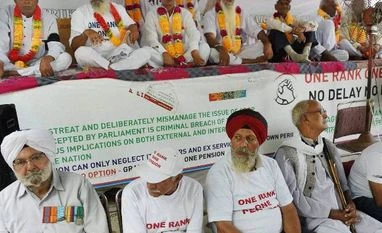 "Ex-servicemen protesting for One Rank One Pension at Jantar Mantar in New Delhi")
Ex-servicemen protesting for One Rank One Pension at Jantar Mantar in New Delhi
One Rank One Pension (OROP), the contours of which was announced by Defence Minister Manohar Parrikar on Saturday, would further strain the fiscal situation and might lead to a review of the government's medium term expenditure, senior government officials said.
The announcement would hit government coffers by Rs 18,000-22,000 crore this financial year. Defence pensions are budgeted at Rs 54,500 crore in 2015-16, which will now climb to Rs 72,500-76,500 crore, approaching the Rs 75,103 crore salary and allowances of defence personnel during the year.
Finance Minister Arun Jaitley had said in Parliament the Centre's salary bill would rise 9.56 per cent to Rs 1,00,619 crore from Rs 91,839 crore in 2015-16 on the recommendations of the Seventh Pay Commission, likely to be made to the government in December.

The combined effect would be a Rs 25,000 crore rise in the Centre's pay and pensions outgo this fiscal year.
However, softening crude oil and commodity prices will reduce subsidies estimated at Rs 2.27 lakh crore for 2015-16. Indirect tax collections, which grew 37 per cent boosted by a 65 per cent jump in factory gate duties, will also ease the burden. As will a 30 per cent jump in service tax in the first four months of 2015-16.
Global crude oil prices are in the low $40s a barrel against $70 budget makers used for this year's fiscal calculations. This is expected to lead to big savings in fuel and fertiliser subsidies.
The Centre's fiscal deficit is now at 70 per cent of the Rs 5.55 lakh crore projection made for the entire year. In his budget for 2015-16, Jaitley had eased the deficit target for 2015-16 to 3.9 per cent of the gross domestic product. It would have been 3.6 per cent according to an earlier consolidation roadmap.
The government has spending room to increase public spending in infrastructure, one of the National Democratic Alliance government's objectives this year. After a squeeze over two years, capital expenditure rose 39 per cent to Rs 86,026 crore in the first four months of 2015-16 from Rs 61,889 crore in the same period a year ago.
Total pensions of Rs 88,521 crore budgeted for 2015-16 constituted 37 per cent of the Rs 2.41 lakh crore capital expenditure. This ratio will rise after OROP and the Seventh Pay Commission's recommendations.
"The Medium Term Expenditure Framework may have to be reworked now. The Centre's previous calculations may go out of the window. Work on that is likely to start soon," said an official. The Medium Term Expenditure Framework Statement is presented to Parliament under Section 3 of the Fiscal Responsibility and Budget Management Act, 2003, and sets out a three-year rolling target for expenditure indicators. Tabled by Jaitley in Parliament in August, the statement projects central government pensions, which includes defence, at Rs 1.03 lakh crore for 2016-17 and Rs 1.13 lakh crore for 2017-18. These numbers are now set to increase.
Parrikar announced the government there would be a revision of pensions every five years under OROP as against two years demanded by ex-servicemen. The base year would be 2013 for calculation of OROP and it would be implemented from July 2014, he said while making it clear that ex-servicemen who had taken voluntary retirement would not be eligible.
The government is also setting up a judicial committee to work out the details of implementation of OROP. The committee would file a report in six months, the minister said.
"OROP is a complex issue. A thorough examination of interests of retirees of different periods and different ranks is needed. Inter-service issues of the three forces also require consideration. This is not an administrative matter alone," said Parrikar while maintaining that the estimated cost of the scheme would be Rs 8,000-10,000 crore.
Expenditure on arrears was estimated at Rs 10,000-12,000 crore, an official statement said. Parrikar said arrears would be paid in four half-yearly installments. However, widows, including war widows, will be receive arrears at one go.
Don't miss the most important news and views of the day. Get them on our Telegram channel
First Published: Sep 05 2015 | 10:58 PM IST