


Supreme Court verdicts that made headlines
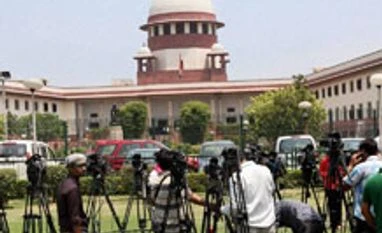)
Media persons outside Supreme Court
In the last five years or so, the Supreme Court has often stepped into public domain. Its decisions, mostly resulting from public interest litigation, provided reprieves to commoners and the business community alike.
It ruled in favour of Hutch-Vodafone in the Rs 12,000-crore tax dispute case and tried to decriminalise politics, with immediate disqualification of convicted lawmakers and legislators. Other significant judgments included directing the Election Commission to introduce the 'none of the above' option in electronic voting machines and debarring VIPs from using red beacons on their cars.
But the most important verdicts were the cancellation of 2G telecom licences in the spectrum allocation scam, the annulment of P J Thomas's appointment as chief vigilance commissioner and monitoring the Central Bureau of Investigation (CBI) probe into the coal block allocation scam, which allegedly took place when Prime Minister Manmohan Singh was in charge of the coal ministry. (SC JUDGMENTS: BOUQUETS AND BRICKBATS)

These rulings caused embarrassment to the Congress-led United Progressive Alliance government, already faced with a myriad of corruption scandals and allegations of impropriety. Though many hailed the rulings, a section, in hushed voices, termed these an unhealthy precedent and the result of judicial activism.
However, the court's recent judgment on homosexuality, dismissing a Delhi High Court judgment and upholding the legal validity of Indian Penal Code section 377, has generated more heat than light. "The court's decision is morally regressive, constitutionally dubious and legally arbitrary and smacks of the kind of hypocrisy that gives the rule of law and the institutions that uphold it a bad name," Pratap Bhanu Mehta, president, Centre for Policy Research, wrote in The Indian Express.
Anand Grover, who fought for the cause of homosexuals, said either the court didn't understand the issue or refused to understand it. "This is blot on SC's reputation. It is reversing the trend," he said.The judgment in the Aruna Shanbaug case, too, had received a mixed response. In March 2011, though the court allowed passive euthanasia in rare cases, it refused this to Shanbaug, who has been in a vegetative state since she was brutally sexually assaulted in 1973.
Though courts are seen as saviors of public rights, they have limitations. In the Supreme Court, each case is decided by a different bench; the outlook may vary from one judge to another. "There is some sort of inconsistency in orders. The judgment in the latest case is not in lines with the current times," says Cyril Shroff of Amarchand & Mangaldas & Suresh A Shroff & Co.
Rajiv Luthra, founder and managing partner of Luthra & Luthra Law Offices, said: "There are clearly two schools of thought. One simply sticks to the laid down laws while the other interprets the law which may tend to rewrite it. The Delhi High Court interpreted the law and rewrote it, in case of homosexuality. The, hon arable SC judges refused to interpret the law by simply pointing out that formation of law is purely the discretion of the parliament."
Don't miss the most important news and views of the day. Get them on our Telegram channel
First Published: Dec 14 2013 | 10:35 PM IST