


Talgo covers Delhi-Mumbai in 12 hrs, completes trial runs in India
The Spanish-made high-speed train clocks up to 150 km an hour
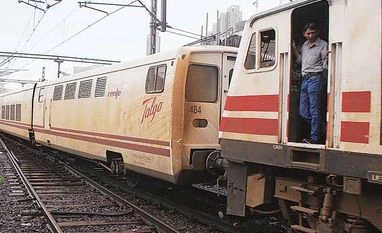 "Talgo covers Delhi-Mumbai in 12 hrs, completes trial runs in India")
The Indian Railways completed the final trial run of high-speed train Talgo on Sunday, covering the 1,384-km Delhi-Mumbai route in a record time of 11 hours and 42 minutes, clocking up to 150 km an hour.
Rajdhani Express takes 15 hours and 50 minutes to cover the same distance, at 130 kmph. "The test run of aluminium-body, light-weight rolling was successful and we were able to hit 150 kmph, covering the distance in 11 hours 42 minutes," said Railway Board Member (Traffic) Mohammad Jamshed.
The Spanish-made high-speed train departed from New Delhi station at 2.45 pm on Saturday and reached Mumbai Central station at 2.33 am on Sunday. This was the fourth trial run on the Delhi-Mumbai route. Talgo had trial runs in the high-traffic routes of Delhi-Mumbai, Mathura-Palwal and Bareilly-Moradabad in August.

The first trial run on the Delhi-Mumbai route was on August 2, when the train took 15 hours and 50 minutes to reach the destination, against the expected 12 hours and 47 minutes. In the second trial run on August 5, while the claim was 12.47 hours, it took 13.17 hours to reach the destination. During the third trial on August 9, the train took 12.56 hours, compared to a claim of 12.26 hours by the company.
In August, Talgo became the fastest train to run in India, clocking a speed of 180 km an hour, covering the 84-km stretch between Mathura and Palwal in 38 minutes flat, breaking the record set by the Gatimaan Express in April.
Rlys Defends Flexi-Fare Pricing
The Railways on Sunday defended its decision to go ahead with surge pricing, saying rail travel is still the cheapest mode of transport in the country. The new form of pricing was introduced for premier trains such as Rajdhani, Shatabdi and Duronto, with effect from September 9.
"In the past two days, we had a higher occupancy rate. We had 118 per cent occupancy rate on September 9 and 127 per cent on September 10, compared to 89 per cent and 79 per cent in the same period last year," Jamshed added.
On September 9, the Railways got additional revenue of Rs 84 lakh and on September 10, the additional revenue stood at Rs 80 lakh thanks to the introduction of the scheme. While 21,000 tickets got reserved for these premium trains on the first day, another 29,000 were reserved on the second.
This dynamic faring system will be applicable for 142 premium trains running across the country comprising 54 Duronto, 46 Shatabdi, and 42 Rajdhani trains. On a daily basis, about 150,000 people are travelling through these trains.
Don't miss the most important news and views of the day. Get them on our Telegram channel
First Published: Sep 11 2016 | 11:04 PM IST