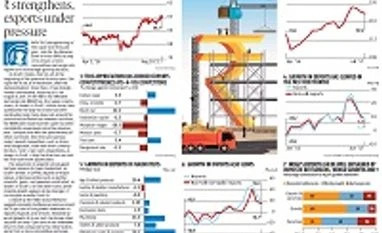
As Chart 1 shows, from 66.2/$ at the beginning of the previous financial year, the rupee fell to 68.8 in November, after the demonetisation.
Since then, it has strengthened considerably, touching 63.6 on August 8, 2017. On the RBI’s real effective exchange rate (REER) too, the rupee is overvalued, as shown in Chart 2.
The expansion in exports since August last year appears to have moderated, as Chart 4 shows.
In Q1FY18, exports of major labour-intensive sectors such as leather products, gems, and jewellery contracted, as shown in Chart 5.
On the other hand, while imports growth appears to be stronger, it has dipped recently (Chart 6).
A report by the HSBC Global Research suggests domestic bottlenecks alone account for 50 per cent of the growth slowdown in exports of goods and services, followed by world growth at 33 per cent. Exchange rates account for only 17 per cent of the slowdown (Chart 7). But compared to the other factors, gains from a more competitive exchange rate are easily secured and accrue in the near-term.


 "Statsguru")