


Rural wages in West Bengal set to take a hit as migrant workers return home
Many fear they will run out of money soon, as they are seen as a burden on the rural economy; most are ostracised due to social distancing
 "coronavirus")
premium
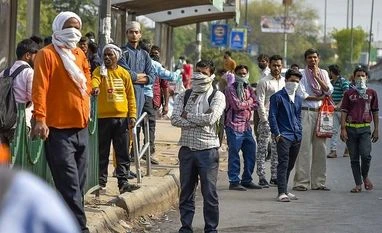
The business of migration is itself an industry in parts of rural Bengal | Photo: PTI
At Gobardhanpur, one of the last of West Bengal's villages falling in the deltaic Sundarban region, there is a deep fear of Coronavirus outbreak among locals. In just two days, March 19 and 20 , and before interstate train services were suspended on March 21, hundreds of migrant workers arrived in the area mostly from southern states, say locals.
“Two days prior to lockdown, close to 100 people came to two villages here. The villagers immediately informed the local administration, which instructed these migrant workers to stay at home. Now villagers are keeping a strict vigil on their movements,” says Biswadip Sahu, a fisherman at Gobardhanpur.
Hiron Raut, along with nine others arrived at his native Buraburir Tat, a village adjacent to Gobardhapur, some 10 days back from Kerala, where he was earning Rs 600-900 a day as a construction worker. His savings will soon be exhausted and he stares at an uncertain future. The West Bengal government has announced an aid of Rs 1,000 a month to daily wage earners in the state.
“Whatever money we had will be exhausted in the next 15-20 days. I don’t know how I will survive after that. I am not sure how long the government will support us,” says Raut.
The thousands of workers returning home to West Bengal amid the pandemic are being seen as a liability and unwelcome guests in their own homes. Meanwhile, the distress in rural economy is already visible.
“Many small grocery shops in rural areas have permanently shut down as they are unable to buy essential food items at high price from big traders. This rural distress might assume mammoth proportions. As far as these migrant workers are concerned, they are quite prone to exploitation as there will be an oversupply for labour in rural areas,” said Dilip Benerjee, an Ashoka fellow who has studied migration pattern in West Bengal.
“The migrant workers who are now back home are seen as huge burden on the local economy. They don’t have requisite skills to be employed in agriculture,” says Aniruddha Dey, Executive Director, Professional Institute for Development & Socio Environmental Management (PRISM), an environment consultancy firm.
Indrajit Das, a textile worker in Tamil Nadu, fears he will be forced to take up farming, the only source of livelihood at Chimta in the Sundarbans, a village that is yet to get a power connection.
“It will be a big challenge for me to take up farming, as I have never done it before. But I will be forced to now, if things remain like this for long,” says Das.
However, Das considers himself lucky to have come back home. His fellow workers informed him from Chennai a day ago that they were having tough time getting meals twice a day.
“Two days prior to lockdown, close to 100 people came to two villages here. The villagers immediately informed the local administration, which instructed these migrant workers to stay at home. Now villagers are keeping a strict vigil on their movements,” says Biswadip Sahu, a fisherman at Gobardhanpur.
Hiron Raut, along with nine others arrived at his native Buraburir Tat, a village adjacent to Gobardhapur, some 10 days back from Kerala, where he was earning Rs 600-900 a day as a construction worker. His savings will soon be exhausted and he stares at an uncertain future. The West Bengal government has announced an aid of Rs 1,000 a month to daily wage earners in the state.
“Whatever money we had will be exhausted in the next 15-20 days. I don’t know how I will survive after that. I am not sure how long the government will support us,” says Raut.
The thousands of workers returning home to West Bengal amid the pandemic are being seen as a liability and unwelcome guests in their own homes. Meanwhile, the distress in rural economy is already visible.
“Many small grocery shops in rural areas have permanently shut down as they are unable to buy essential food items at high price from big traders. This rural distress might assume mammoth proportions. As far as these migrant workers are concerned, they are quite prone to exploitation as there will be an oversupply for labour in rural areas,” said Dilip Benerjee, an Ashoka fellow who has studied migration pattern in West Bengal.
“The migrant workers who are now back home are seen as huge burden on the local economy. They don’t have requisite skills to be employed in agriculture,” says Aniruddha Dey, Executive Director, Professional Institute for Development & Socio Environmental Management (PRISM), an environment consultancy firm.
Indrajit Das, a textile worker in Tamil Nadu, fears he will be forced to take up farming, the only source of livelihood at Chimta in the Sundarbans, a village that is yet to get a power connection.
“It will be a big challenge for me to take up farming, as I have never done it before. But I will be forced to now, if things remain like this for long,” says Das.
However, Das considers himself lucky to have come back home. His fellow workers informed him from Chennai a day ago that they were having tough time getting meals twice a day.