A statement from Downing Street indicated the rule will be imposed “10 years earlier than planned”. It also elucidated the government “will allow the sale of hybrid cars and vans that can drive a significant distance with no carbon coming out of the tailpipe until 2015”.
JLR, acquired by the Tatas in 2008, is the UK’s largest automotive manufacturer, accounting for an estimated 30 per cent of all domestic car production in this country. It has set records in the past of generating 1.75 million units in a year.
A spokesperson for the company said: “At JLR, we have already embraced the direction of the government’s announcement, investing heavily in fully electric and plug-in hybrid vehicles for a zero emissions future.”
She added: “Our award-winning Jaguar I-PACE was the first premium all-electric sport utility vehicle launched to global critical.” The I-PACE series of three cars retail at upmarket prices of between £65,000 and £74,000.
She further elaborated “available to order” options include plug-in hybrids for Jaguar F-PACE and Jaguar E-PACE and mild-hybrids for Jaguar XE and Jaguar XF.
Barring this year, in which the motor vehicle industry has been buffeted by the ill-winds of Covid-19, JLR has been a striking success since the Tatas purchased it in an ailing condition. Following his induction into the 2015 Automotive Hall of Fame in Detroit in 2015, Ratan Tata modestly remarked: “Personally I am very, very proud of what we have achieved at JLR, though I cannot take too much of the credit.”
But Jaguar was slow on the uptake in adopting electric and hybrid vehicles, compared to their German competitors and most certainly their Japanese rivals.
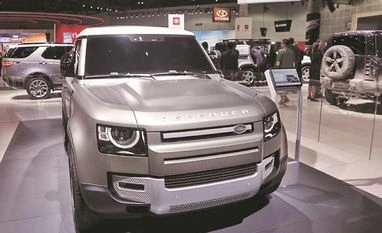
Land Rover does not as yet offer an electric model. It, though, displays a wide choice of hybrid vehicles, as for example Discovery Sport, various ones in the Range Rover category and Defender as plug-in hybrids and Land Rover Discovery as a mild-hybrid — all on an available to order basis, the spokesperson outlined.
It’s unclear what Jaguar’s intentions are to introduce more electric or hybrid cars or Land Rover’s for that matter to come up with an electric vehicle. But the information Johnson’s office provided was the prime minister had held “extensive consultation with car manufacturers and sellers” before he made the announcement. This means JLR knew in advance what was made public.
It is not known yet whether JLR will continue to make petrol and diesel automobiles after 2030 for markets other than the UK which may permit them. This, for instance, could continue in crude oil-rich countries as well as in nations unable or unwilling to crack down aggressively on fossil fuels.
JLR has not ventured into gas-powered technology. In fact, such cars are rare all over Europe, although common among public transport buses.
Germany-based Audi has disclosed its gas-powered A5 will cost the same as its diesel model, but would need far less exhaust after-treatment. It will be lighter than an electric car, less expensive, and simpler in terms of battery configuration.


 "JLR")