


The pillar of our development model is creation of jobs: Vasundhara Raje
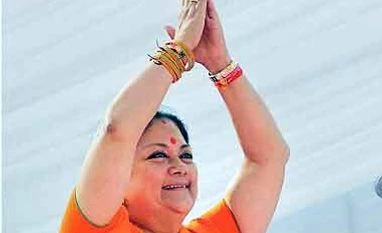 "The pillar of our development model is creation of jobs: Vasundhara Raje")
Vasundhara Raje Scindia
Edited excerpts from the speech of Chief Minister Vasundhara Raje at the Business Standard Round Table, held recently in Jaipur:
It gives me immense pleasure to share with this august gathering my thoughts about the progress of Rajasthan and its people.
“Rajasthan — 10 per cent of India, 75 million people, starved of water and with poor development indices — that is what the rest of the country saw us for. Today, the Rajasthan model of development, based on the triad of social justice, effective governance and job creation, is working to ensure continued growth and progress.
“Shri Atal Bihari Vajpayee ji had remarked that, ‘Freedom is incomplete without social justice’. Education is the most potent catalyst of social justice. With this understanding we amended the Right to Education Act, so that we could grant our children the right to proper learning. We have rationalised our schools and every Gram Panchayat has a fully equipped and staffed Adarsh Vidyalaya. Our curricula are being recast with the aim of giving our children the tools to do well in the real world.
“What is education without skills? The higher education system in our country grants degrees which rarely if ever bring with them employability. Rajasthan has a vibrant industry-skill development linkage and the network of Skill Development Centres and ITIs creates skilled workforce who are in demand. In many cases, ITIs have been adopted by industry to produce human resources as per their own requirements.
“If our men and women do not have jobs, there is going to be little by way of development. For us in Rajasthan, a pillar of our model of development is generation of remunerative employment. We understand that industry and services are key areas that will create sustainable livelihoods, and hence our support to industrial resurgence.
“Uplifting the agriculture sector is an essential element of job creation. We are working on maximising farm incomes through crop diversification, value addition and productivity enhancement, with strong emphasis on livestock development. Solar pumps, green houses, poly tubes are becoming increasingly popular and Rajasthan today grows olives, dates and strawberries. The next step is to bring to the farmer the best in technology. In November this year, the Global Rajasthan Agritech Meet is being organised with this objective in mind.
“We asked ourselves that why should only Bangalore be the Mecca of start-ups. The youth of Rajasthan are talented and zealous. We went on to formulate our start-up policy and have set up incubators that will help transform Jaipur, Udaipur, Kota, Ajmer into start-up destinations of this country. To realise the dream of a knowledge-driven society, Digital Rajasthan becomes a powerful platform. We are committed to being a partner in Digital India through our efforts in Smart City, e-governance, Smart Grids and more.
“The merits of financial inclusion are deeply rooted in empowerment of citizens and access to credit is a critical link between economic opportunities and outcomes. Our Bhamashah Scheme is a case in point. It is India’s first-of-its-kind direct benefit transfer scheme. Already, more than 73 million transactions amounting to nearly Rs 3,200 crore have taken place on Bhamashah.
“Effective governance is not really about ‘correct’ decisions, but about the best possible process for making those decisions. With over 500 laws in the statute book, there was a crying need to do away with outdated, irrelevant and ineffective laws that made little sense in a modern, business-friendly economy. Rajasthan has been one of the first states in India to rationalise archaic laws and has already repealed 61 Principal Acts and 187 Amending Acts out of 592 Acts.
“The industrial prowess of a nation depends on a healthy mix between large industry and small and medium enterprises. As a member of the Central Council of Ministers in charge of small-scale industry, I had experienced the potential and capabilities of SMEs in growth and employment generation. This learning was married to widespread consultations, leading to labour-sector reforms that aimed at ease of doing business by small units, without compromising the interests of labour. Today, our reforms are the benchmark for the rest of the country.
“Rajasthan, in a significant move, has recently introduced an online advanced single window clearance service — which allows time-bound issue of various clearances for project and investment proposals. A large number of clearances have been replaced with self-certification, making environment clearances easier and speedy.
“You will be happy to note that our unified tax form is in sync with online operations. Rationalisation of tax systems has led to increased competitiveness. We have a new policy for allotting land to provide ‘plug and play’ facilities for non-polluting units. This pioneering EODB initiative has been welcomed by all. We have simplified procedure in different sectors. Our solar energy policy allows easy handshakes between landowners and investors. Our land pooling law incentivises co-operation between landowners and those entrusted with creation of infrastructure.
“Justice and governance go hand in hand. The emotional connect people have with land often leads to petty disputes between family members and neighbours. To address this sensitive area, for two successive years we organised the Nyay Aapke Dwar campaign, which saw revenue officials conducting camps to resolve court matters, issue certificates and counsel families and neighbours on disputes. More than 69 lakh families have been benefited in these camps.
“For a land-locked state with few perennial surface water sources, sustainable harvesting and conservation of rainwater is vital to the future of the state. Our water conservation campaign in 3500 villages this year saw government departments, industry, trusts, uniformed services, NGOs and individuals come together to rehabilitate and even construct 92,000 water harvesting structures and with the rains, plant 25 lakh saplings.
“Tourism has been a strength of the state. Our multimodal, multi-narrative multi-year global campaign is underway and we are targeting 50 million tourist arrivals by 2020. Two hundred and twenty-one MoUs for setting up new Tourism Units have been signed and are being processed for implementation.
“Coming to Resurgent Rajasthan, our aim never was to achieve numbers. We engaged with our industry partners and presented them incentives that were attractive. Four hundred and seventy MoUs with an investment projection of $50.26 billion have been signed so far. A large proportion are in various stages of implementation.
“The urban market place with its wide range of consumer products has always attracted the rural consumer. The old Fair Price Shop, if at all, pulled up its shutters occasionally and offered very little in terms of choice. In Rajasthan today we have Annapurna Bhandars — a public-private partnership with the Future Group — to provide multi-brand retail products of daily use at competitive prices. Further, biometric identification and POS machines at Fair Price Shops have significantly reduced leakages and eliminated ghost beneficiaries.
“If India has to prosper in the true sense, we need to chart a course where co-operative federalism will pave the path to inclusive growth, effective governance and sustainable resource management in all states. This can only happen when the welfare of the country comes before politics.”
It gives me immense pleasure to share with this august gathering my thoughts about the progress of Rajasthan and its people.
“Rajasthan — 10 per cent of India, 75 million people, starved of water and with poor development indices — that is what the rest of the country saw us for. Today, the Rajasthan model of development, based on the triad of social justice, effective governance and job creation, is working to ensure continued growth and progress.

“Shri Atal Bihari Vajpayee ji had remarked that, ‘Freedom is incomplete without social justice’. Education is the most potent catalyst of social justice. With this understanding we amended the Right to Education Act, so that we could grant our children the right to proper learning. We have rationalised our schools and every Gram Panchayat has a fully equipped and staffed Adarsh Vidyalaya. Our curricula are being recast with the aim of giving our children the tools to do well in the real world.
“What is education without skills? The higher education system in our country grants degrees which rarely if ever bring with them employability. Rajasthan has a vibrant industry-skill development linkage and the network of Skill Development Centres and ITIs creates skilled workforce who are in demand. In many cases, ITIs have been adopted by industry to produce human resources as per their own requirements.
“If our men and women do not have jobs, there is going to be little by way of development. For us in Rajasthan, a pillar of our model of development is generation of remunerative employment. We understand that industry and services are key areas that will create sustainable livelihoods, and hence our support to industrial resurgence.
“Uplifting the agriculture sector is an essential element of job creation. We are working on maximising farm incomes through crop diversification, value addition and productivity enhancement, with strong emphasis on livestock development. Solar pumps, green houses, poly tubes are becoming increasingly popular and Rajasthan today grows olives, dates and strawberries. The next step is to bring to the farmer the best in technology. In November this year, the Global Rajasthan Agritech Meet is being organised with this objective in mind.
“We asked ourselves that why should only Bangalore be the Mecca of start-ups. The youth of Rajasthan are talented and zealous. We went on to formulate our start-up policy and have set up incubators that will help transform Jaipur, Udaipur, Kota, Ajmer into start-up destinations of this country. To realise the dream of a knowledge-driven society, Digital Rajasthan becomes a powerful platform. We are committed to being a partner in Digital India through our efforts in Smart City, e-governance, Smart Grids and more.
“The merits of financial inclusion are deeply rooted in empowerment of citizens and access to credit is a critical link between economic opportunities and outcomes. Our Bhamashah Scheme is a case in point. It is India’s first-of-its-kind direct benefit transfer scheme. Already, more than 73 million transactions amounting to nearly Rs 3,200 crore have taken place on Bhamashah.
“Effective governance is not really about ‘correct’ decisions, but about the best possible process for making those decisions. With over 500 laws in the statute book, there was a crying need to do away with outdated, irrelevant and ineffective laws that made little sense in a modern, business-friendly economy. Rajasthan has been one of the first states in India to rationalise archaic laws and has already repealed 61 Principal Acts and 187 Amending Acts out of 592 Acts.
“The industrial prowess of a nation depends on a healthy mix between large industry and small and medium enterprises. As a member of the Central Council of Ministers in charge of small-scale industry, I had experienced the potential and capabilities of SMEs in growth and employment generation. This learning was married to widespread consultations, leading to labour-sector reforms that aimed at ease of doing business by small units, without compromising the interests of labour. Today, our reforms are the benchmark for the rest of the country.
“Rajasthan, in a significant move, has recently introduced an online advanced single window clearance service — which allows time-bound issue of various clearances for project and investment proposals. A large number of clearances have been replaced with self-certification, making environment clearances easier and speedy.
“You will be happy to note that our unified tax form is in sync with online operations. Rationalisation of tax systems has led to increased competitiveness. We have a new policy for allotting land to provide ‘plug and play’ facilities for non-polluting units. This pioneering EODB initiative has been welcomed by all. We have simplified procedure in different sectors. Our solar energy policy allows easy handshakes between landowners and investors. Our land pooling law incentivises co-operation between landowners and those entrusted with creation of infrastructure.
“Justice and governance go hand in hand. The emotional connect people have with land often leads to petty disputes between family members and neighbours. To address this sensitive area, for two successive years we organised the Nyay Aapke Dwar campaign, which saw revenue officials conducting camps to resolve court matters, issue certificates and counsel families and neighbours on disputes. More than 69 lakh families have been benefited in these camps.
“For a land-locked state with few perennial surface water sources, sustainable harvesting and conservation of rainwater is vital to the future of the state. Our water conservation campaign in 3500 villages this year saw government departments, industry, trusts, uniformed services, NGOs and individuals come together to rehabilitate and even construct 92,000 water harvesting structures and with the rains, plant 25 lakh saplings.
“Tourism has been a strength of the state. Our multimodal, multi-narrative multi-year global campaign is underway and we are targeting 50 million tourist arrivals by 2020. Two hundred and twenty-one MoUs for setting up new Tourism Units have been signed and are being processed for implementation.
“Coming to Resurgent Rajasthan, our aim never was to achieve numbers. We engaged with our industry partners and presented them incentives that were attractive. Four hundred and seventy MoUs with an investment projection of $50.26 billion have been signed so far. A large proportion are in various stages of implementation.
“The urban market place with its wide range of consumer products has always attracted the rural consumer. The old Fair Price Shop, if at all, pulled up its shutters occasionally and offered very little in terms of choice. In Rajasthan today we have Annapurna Bhandars — a public-private partnership with the Future Group — to provide multi-brand retail products of daily use at competitive prices. Further, biometric identification and POS machines at Fair Price Shops have significantly reduced leakages and eliminated ghost beneficiaries.
“If India has to prosper in the true sense, we need to chart a course where co-operative federalism will pave the path to inclusive growth, effective governance and sustainable resource management in all states. This can only happen when the welfare of the country comes before politics.”
Don't miss the most important news and views of the day. Get them on our Telegram channel
First Published: Aug 21 2016 | 9:46 PM IST