


With US interest rates heading upwards, how will India fare?
The committee now projects the federal funds rate at 0.9 per cent by the end of 2016, perking up to 1.6 per cent by 2017
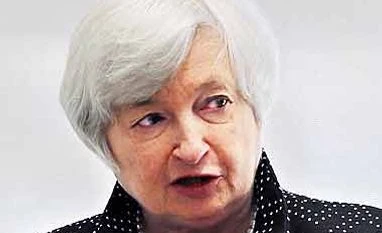 "Janet Yellen")
premium
Janet Yellen
On Wednesday, the US Federal Reserve chose to keep the federal funds rate unchanged. But the forward guidance provided by the committee suggests that the Fed is on course to raise interest rates during the course of the year. The committee now projects the federal funds rate at 0.9 per cent by the end of 2016, perking up to 1.6 per cent by 2017.
With higher interest rates in the US all but a certainty, will it lead to an exodus of portfolio money from emerging markets, especially India? Will the rupee succumb under pressure as risk-averse investors pull back from emerging markets or will markets take future hikes in its stride? Consider for instance in June 2013, when talk about the US Federal Reserve rolling back its massive monetary stimulus first surfaced. Emerging market (EM) currencies plummeted. The rupee fell by over 10 per cent by August.
But fast forward to December 2015 when the Fed raised its benchmark interest rate by 25 basis points. The reaction, this time around, was subdued. The rupee depreciated by 3.4 per cent by January and another one per cent in February. How will markets react now when the US transitions to a tighter monetary regime? The analyst and investor community seems confident that India is well placed to weather the storm. "India is now better prepared to deal with an interest rate hike in the US," says Dipen Shah, senior vice-president and head, private client group research, Kotak Securities. "A rate hike is now largely discounted by the market," he adds.
With higher interest rates in the US all but a certainty, will it lead to an exodus of portfolio money from emerging markets, especially India? Will the rupee succumb under pressure as risk-averse investors pull back from emerging markets or will markets take future hikes in its stride? Consider for instance in June 2013, when talk about the US Federal Reserve rolling back its massive monetary stimulus first surfaced. Emerging market (EM) currencies plummeted. The rupee fell by over 10 per cent by August.
But fast forward to December 2015 when the Fed raised its benchmark interest rate by 25 basis points. The reaction, this time around, was subdued. The rupee depreciated by 3.4 per cent by January and another one per cent in February. How will markets react now when the US transitions to a tighter monetary regime? The analyst and investor community seems confident that India is well placed to weather the storm. "India is now better prepared to deal with an interest rate hike in the US," says Dipen Shah, senior vice-president and head, private client group research, Kotak Securities. "A rate hike is now largely discounted by the market," he adds.