


Home / World News / Tesla projected to win US electric-car race
Tesla projected to win US electric-car race
Tesla is predicted to pull away from current leader GM, which may slip behind Volkswagen's sales
 "Tesla")
premium
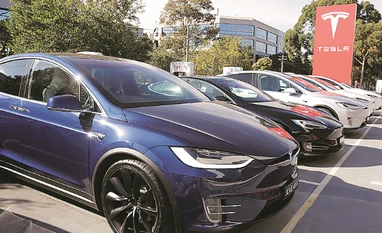
Executing a smooth introduction of the Model 3 as demand for the Model S sedan and Model X sport utility vehicle flatline has sapped from Tesla’s stock surge this year (Photo: Reuters)
Last Updated : Jul 07 2017 | 3:59 AM IST
More than a dozen automakers are jostling to lead the US electric-car race, but Bloomberg New Energy Finance sees a clear winner separating from the pack: Tesla.
The automaker led by Chief Executive Officer Elon Musk will emerge as “the stand-out” in total cumulative deliveries through 2021, reaching nearly 709,000 vehicles, according to BNEF’s Long-Term Electric Vehicle Outlook released Thursday. Tesla is projected to pull away from current leader General Motors, which may slip behind Volkswagen AG’s aggregate sales of plug-in hybrid and fully electric autos in four years’ time.
The report reinforces the optimism among some analysts that Tesla will be able to distance itself from established automakers and dominate many of the world’s biggest markets for battery-powered vehicles. That enthusiasm has been dampened this week by plateauing deliveries of Model S and Model X vehicles ahead of the introduction of Musk’s most affordable sedan yet, the Model 3.
“If they can stick to the Model 3 timeline, they’re going to be at the front edge of this for a while,” BNEF analyst Colin McKerracher said of Tesla in a phone interview.
Executing a smooth introduction of the Model 3 as demand for the Model S sedan and Model X sport utility vehicle flatline has sapped from Tesla’s stock surge this year. The shares fell as much as 5.3 per cent Thursday after a 7.5 per cent plunge Wednesday, the steepest one-day drop in more than a year. The drubbing has dropped Tesla’s market capitalisation back below GM for the first time in more than six weeks.
While BNEF expects Tesla, Volkswagen and GM will lead the EV charge in 2021, the research group owned by Bloomberg LP predicts at least three other automakers will have also surpassed the 200,000 cumulative sales mark in the US by that year. After crossing that threshold, buyers are no longer eligible for the full federal $7,500 tax credit toward purchases of vehicles from those manufacturers.
Hitting the 200,000 unit milestone would portend more sustainable demand for electric vehicles. Though BNEF does expect some impact from the federal tax credit phase-out, industry sales could be even higher because the analysts’ short-term forecasts are based only on electrified models disclosed to date.
Product introduction schedules for 2020 and 2021 are still taking shape. BNEF made its forecasts before Volvo said Wednesday it’ll have five electric models in its lineup by 2021 and that all of its new models will have hybrid or fully electric powertrains from 2019.
“Tesla will face intense competition by next decade from legacy OEMs who are expanding their electric options,” Brian Johnson, an analyst at Barclays Plc, wrote in a note to clients Wednesday. “We’ve long argued that Tesla as an EV company is not truly disruptive, in that legacy OEMs will eventually wake up and offer fully electric vehicles by the early 2020s.”
The prediction BNEF settled on that Volkswagen could climb to the No. 2 spot by 2021 was the “the most contentious” of the research group’s projections, McKerracher said. The German automaker doesn’t yet have the same presence in the U.S. market as other electric-focused automakers, though the opportunity is there for the company to rank among the leaders based on all the vehicle launches it’s announced.
Hybrid outlook
The expected rise in pure electric vehicle demand in the U.S. will come at the expense of some hybrid vehicle demand, BNEF said. This could pose a challenge for the likes of Toyota Motor Corp., known for gasoline-electric cars like the Prius. The company sold about 1.4 million traditional and plug-in hybrid vehicles last year and has delivered more than 10 million cumulatively since the first Prius debuted in 1997.
Battery electric cars have already surpassed plug-in electric hybrids in the U.S., with about 85,000 and 73,000 sold last year respectively, BNEF data show. The trend also holds globally, with 412,000 battery electric vehicles sold last year to 283,000 plug-in hybrids.
BNEF expects Toyota’s Prius Prime plug-in hybrid to be the exception and hold the title of best-selling electrified vehicle in the U.S. this year. Tesla will get off to too late of a start with its Model 3 to catch up, with Musk planning to hold a handover party for its first 30 sedan customers on July 28. The company is aiming to ramp-up production to a rate of 20,000 cars per month in December.
“In the long term, we see battery electric vehicles winning because of the battery cost curve,” McKerracher said.