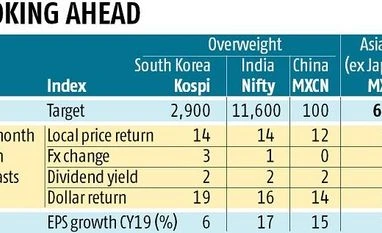
Source: Goldman Sachs Global Investment Research
India is among the three overweight markets (South Korea and China being the other two) for Goldman Sachs in the Asia Pacific (ex-Japan) region. “The underlying theme behind our overweight stance in these three markets is that we have strongest confidence in earnings being delivered for not only 2018, but also 2019,” said Moe.
The brokerage’s robust earnings growth forecasts are supported by its view that economic growth will accelerate globally and also in Asia. Goldman Sachs expects global economic growth to accelerate to four per cent in 2018, supported by fiscal stance of global central banks, easing of financial conditions and reduction in excess capacity leading to a pick-up in investment.
Andrew Tilton, chief Asia Pacific economist at Goldman Sachs, said India’s economic growth has been disappointing in the past few quarters due to one-time disruptions such as demonetisation and the goods and services tax (GST). “Absence of new disruptive events in 2018 will help revive growth,” he said.
Tilton said Goldman’s rate-hike forecasts by the US Federal Reserve and the Reserve Bank of India (RBI) is higher than consensus forecasts. Goldman expects the RBI to raise policy rates in 2018, ending the rate easing cycle.
Moe said India’s valuations relative to the MSCI Asia Pacific (ex-Japan) index are expensive and earnings growth will be the key to normalise the valuation.
The MSCI India index currently trades at 18.1 times its 12-month forward earnings estimate, one standard deviation above its long-term average of about 16 times.
Moe said there was room for higher capital inflows into India and other regional markets.
“Overseas investors are still over 500 basis points (bps) underweight on Asia ex-Japan relative to other regions. Even if they get back to average of last 10 years, that will be about 200 bps increase in holdings. This, on the base of $1.1 trillion of global regional funds’ assets, would be $25 billion of new inflows,” he said.
Moe said overseas investors have turned bullish on Indian equities after the government announced the bank recapitalisation programme. So far this month, overseas investors have bought shares worth nearly $3 billion.
He said a lot of global funds had reduced their overweight position on India over the past two years and overseas investors are no longer setting the tone for the Indian market.
“The domestic money is what is dictating the price now. It is no longer the FIIs (foreign institutional investors) who are the price-setters. Indian investors are much more in control of their own destiny. This is something everybody should be proud of,” he said.


 "Graph")