


Devangshu Datta: Teetering on the brink of an abyss
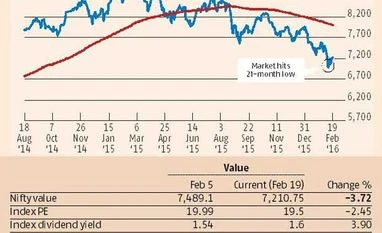
Volatility in the global markets has more than spilled into India. The Sensex, Nifty crashed to new 20-month lows. Exports, imports fell for the 14th consecutive month
 "Devangshu Datta: Teetering on the brink of an abyss")
The global economy continues to experience wild swings affecting forex, bond and commodity markets. That volatility is certainly affecting India. But the focus of attention is now centred on the annual Budget tamasha.
As always, all sorts of rumours and "leaks" abound. Nomura thinks the Budget will be "run of the mill". The fiscal deficit target of 3.9 per cent of gross domestic product will be met. But the Fisc target for 2016-17 may be reset higher, at 3.7 per cent from the earlier projection of 3.5 per cent. Falling crude prices have helped with the Fisc. But the Seventh Central Pay Commission implementation will mean enhanced expenditure.
One of the rumours is pump priming. Will the government pour large sums into infrastructure projects? This may be wishful thinking on the part of infrastructure developers. Credit rating agencies would come down like a ton of bricks on India's sovereign rating if the Fisc climbs too much.
Another rumour: The provisions of long-term capital gains tax will be changed, with the period being extended from the current one year to three years. Some versions of the rumour carry the corollary of removal of security transaction tax. Such changes would have a huge impact on markets.
Not much in the way of non-budgetary work will be transacted in the Budget Session since the Jawaharlal Nehru University fracas has vitiated the relationship with the Opposition. Based on track record, the government lacks the imagination to push through extraordinary measures. The Fisc targets will be met, more or less, since 0.2 per cent is a negligible difference.
Disinvestment targets will likely be lowered in 2016-17 and whatever the targets are, they are almost certain to be missed. The 2015-16 disinvestment target was Rs 69,500 crore and, as of now, the government has collected Rs 12,700 crore. The best "score" in the last five years was the Rs 24,300 crore raised in 2014-15.
Targets for bank recapitalisation may be raised drastically. Public sector banks (PSB) are teetering on the brink of an abyss, with Rs 3 lakh crore of gross non-performing assets (NPA) (about six per cent of collective PSB net worth), Rs 1.74 lakh crore of net NPAs (3.25 per cent of net worth), Rs 2.7 lakh crore of restructured loans and who knows what of evergreen loans that have not yet shown up as NPAs.
This mess must be cleaned up. PSBs must be recapitalised to meet enhanced net-worth considerations, according to Basel III norms. Every PSB is trading well below official book value. The bill for recapitalisation might more than triple from the current commitment of Rs 70,000 crore to well over Rs 2.3 lakh crore.
Other recent data have also been depressing. Retail inflation rose in January, with the Consumer Price Index up 5.69 per cent year-on-year over January 2015. This was the highest since September 2014. Core inflation (ex-food, ex-fuel) was at 4.55 per cent year-on-year and that is the highest in a year. The Index of Industrial Production (IIP) was down in December by minus 1.3 per cent and the November IIP was revised down to minus 3.4 per cent (the initial estimate was 3.3 percent). Exports and imports fell again, for the 14tth month in succession, in January 2016.
Corporate results were abysmal in Q3. For a sample of 2,561 listed companies, collected by Business Standard, net sales fell four per cent, while net profits dropped 1.7 per cent. Interest costs rose four per cent despite falling sales and declining raw material and energy costs. Employee costs also rose, by nine per cent. The Nifty 50 saw earnings dropping by 15 per cent year-on-year on consolidated results.
Foreign institutional investor (FII) sentiment has been poor with over Rs 30,000 crore in net equity sales in 2015-16. By December 2015, FII stakes in India's listed firms had hit 18.67 per cent, down by 1.34 per cent from December 2014. FII holdings were the lowest since March 2013.
Domestic mutual fund inflows to equity are positive but January 2016 inflows were the lowest since the Modi government came to power in May 2014. Attempts to boost investment sentiment via the Make in India jamboree and promises to make it easier to do business were checkmated by the reiteration of retrospective tax demands aimed at Vodafone with threats of asset seizures.
Globally, crude production may be curtailed if the Saudi-Russian pact holds, and if Iran doesn't boost production as it emerges from sanctions, and if the US shale industry can't frack profitably at the prevailing rates. Lots of ifs and buts there.
Currency markets have seen swings all over the shop, with two-way movements in USD and yen baffling traders and central banks alike. The People's Bank of China seems to be trying to push the yuan down again. Europe's traders are nervous about CoCo (Contingent Convertible) bonds where a collapse is feared.
The Sensex and the Nifty crashed to new 20-month lows in early February. There's been a small recovery since. Budget optimists could push prices up in the next week or so. However, if their hopes are belied, March may see the market nosediving again.
Disclaimer: These are personal views of the writer. They do not necessarily reflect the opinion of www.business-standard.com or the Business Standard newspaper

Don't miss the most important news and views of the day. Get them on our Telegram channel
First Published: Feb 21 2016 | 9:44 PM IST