


Diversifying defence
India-Russia relations need careful handling
 "Narendra Modi, Vladimir Putin")
premium
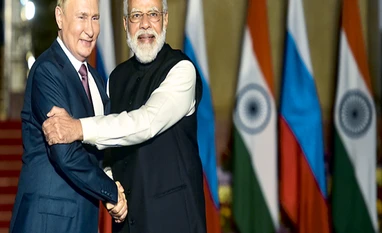
Prime Minister Narendra Modi receives Russian President Vladimir Putin at Hyderabad House in New Delhi, on Monday (Photo: PTI)
If there is a single lesson that India must learn from the ongoing Russia-Ukraine war, it is the need to deliberately diversify the sources from which we procure our defence equipment. At its core, the prime minister’s Aatmanirbhar Bharat (self-sufficient India) campaign aims to rely on nobody but ourselves for the weapons and equipment needed to fight and win a war. However, since full self-sufficiency would take years to achieve, a clear intermediate goal is essential: To ensure that we are not unhealthily dependent on a single country, strategic grouping, or company for our defence equipment. Our reliance on Russia goes back decades and relates not just to basic combat equipment such as rifles, tanks, infantry combat vehicles, and air defence guns, but also increasingly for “sub-strategic” systems that incorporate closely guarded technologies. For example, India has taken from Russia two nuclear-propelled attack submarines (SSN) on successive 10-year leases. Russia has assisted Indian designers in preparing blueprints for India’s indigenous, nuclear-propelled ballistic missile submarines (SSBN). That is something that even the US refused to help New Delhi with, even though Washington makes much of India being America’s “major defence partner”. Moscow’s design assistance has also gone into building the aircraft carrier INS Vikrant. Indian satellite navigation system, called GAGAN, benefits from access to the precision code of Russia’s Global Navigation Satellite System (GLONASS). The two countries have jointly developed the BrahMos supersonic cruise missile, which has become a symbol of Indo-Russian cooperation.