Helicopters have service ceilings of 3,000-4,000 metres, beyond which they struggle to carry full loads. This makes the logistics of supplying installations in high-altitude areas like Siachen and Ladakh very daunting. If the Ingenuity design scales commercially, it would dramatically improve the ability of helicopters to operate at higher altitudes. NASA’s policy of releasing patents means the technology could be inducted commercially without legal hurdles. Helicopters (and fixed-wing aircraft) use wings with curved surfaces to create lift. Air flows at different speeds on the wing’s upper and lower surfaces, to generate lift. Fixed-wing aircraft move forward to create air-flow. Helicopters spin blades. The faster the rotation, the more the lift. “Choppers” have spin rates of 450-500 rpm (rotations per minute). Ingenuity’s blades can rotate at 2,400 rpm. Achieving such high rpm for the one-metre-long blades was big proof of concept for propulsion technology.
Copters have higher mobility. They can hover, and move in any direction, including flying upside down. They are also notoriously hard to control. Blade configurations are complicated. Torque created by one set of blades often has to be balanced by spinning another set of blades in the opposite direction. “Quadcopters” are familiar sights. Many drones use such designs. These are impossible to control except via software, which manages multiple engines, with variable rotor speeds and spin directions. It takes over 20 minutes for a radio signal to travel from Earth to Mars. Ingenuity operated totally autonomously, running its flight according to pre-arranged instructions. This represents significant advances in autonomous aerial technology and, again, it may be possible to induct such improvements into commercial designs.
Coming back to the statistics of the flight, they need to be placed in historical context. The first ever powered flight took place in 1903. The Wright Brothers’ Flyer flew for just 12 seconds and it only rose 3 metres off the ground. So Ingenuity hasn’t done badly at all. The first helicopter design actually dates back to the 1480s. Leonardo Da Vinci conceptualised a two-rotor chopper, powered by a human pedalling a screw mechanism. His design works. It was demonstrated in 2013 with the engineering team winning a $250,000 award. More than 550 years after Da Vinci dreamt up the helicopter, a miniaturised descendant has conquered a new planet.


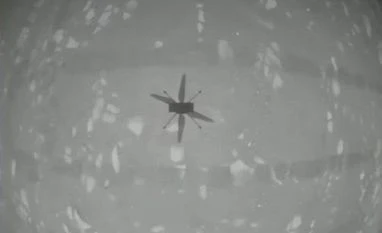 "Ingenuity")