


Ring fence your family's assets with a trust
This vehicle ensures fewer family disputes and smooth distribution of wealth
 "Graph")
premium
Most business families dilly-dally when it comes to the crucial task of succession planning. Developments within the Singhania family highlight the importance of carrying out succession planning in a planned and timely manner. The father gifted the shares of his companies to his son. Ideally, he should have handed over management, but not the ownership of the company. He is perhaps repenting his decision today.
A high level of inertia: Most business families don't begin succession planning in time for fear of opening a Pandora's Box. They feel that initiating the process will disturb the family's harmony. What they don't realise is that sweeping this issue under the carpet doesn't make it go away. The problem only grows bigger over time and has far worse consequences than if it is dealt with on time.
Procrastination is another common reason for not starting the process. Most heads of business families feel that the present is not the right time. Since they are busy people, they keep postponing this crucial task for another day.
Sometimes, patriarchs don't undertake succession planning for fear of losing ownership and control. Such fears are unfounded and arise from lack of knowledge about the trust structure and how it operates. A trust, in fact, allows a lot of flexibility and can be tailored to meet the exact needs and specifications of the patriarch.
Not undertaking succession planning can lead to many negative consequences. The lack of clarity regarding what they will receive often creates a sense of insecurity among the successors. Often, fights erupt because family members are unaware of what their share will be when the assets are finally passed on to them.
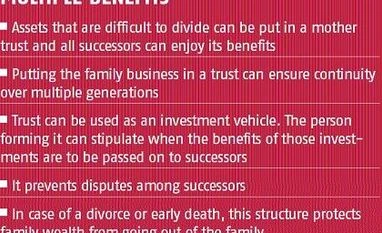
To deal with all these issues, business families need to carry out succession planning through trusts.
A high level of inertia: Most business families don't begin succession planning in time for fear of opening a Pandora's Box. They feel that initiating the process will disturb the family's harmony. What they don't realise is that sweeping this issue under the carpet doesn't make it go away. The problem only grows bigger over time and has far worse consequences than if it is dealt with on time.
Procrastination is another common reason for not starting the process. Most heads of business families feel that the present is not the right time. Since they are busy people, they keep postponing this crucial task for another day.
Sometimes, patriarchs don't undertake succession planning for fear of losing ownership and control. Such fears are unfounded and arise from lack of knowledge about the trust structure and how it operates. A trust, in fact, allows a lot of flexibility and can be tailored to meet the exact needs and specifications of the patriarch.
Not undertaking succession planning can lead to many negative consequences. The lack of clarity regarding what they will receive often creates a sense of insecurity among the successors. Often, fights erupt because family members are unaware of what their share will be when the assets are finally passed on to them.
To deal with all these issues, business families need to carry out succession planning through trusts.