


Home / India News / BJP jolts BJD, Congress in Odisha local polls
BJP jolts BJD, Congress in Odisha local polls
The party has gained at the expense of anti-incumbency sentiment for the BJD and Congress party
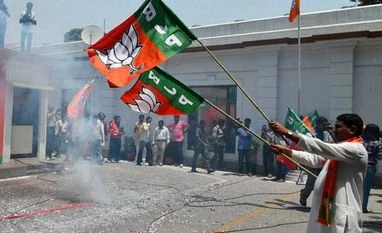 "BJP workers celebrate party victory in Assam 2016 polls")
premium
BJP workers celebrate party victory in Assam 2016 polls
Last Updated : Feb 19 2017 | 12:08 AM IST
The Bharatiya Janata Party (BJP), by all accounts, has got second place in the ongoing panchayat polls in Odisha, after the ruling Biju Janata Dal (BJD), in terms of the number of zilla parishads won.
In the process, it has pushed the Congress, the traditional rival of the BJD in the state for the past two decades, to third spot.
Although the results have not been officially announced, the indications are that the BJD has bagged 290 seats in the first three phases compared to 421 seats it got at the same stage of the previous panchayat polls in 2012.
The BJP, which had got 17 seats in the first three phases of the previous polls, has improved its tally by more than 10 times to win 192 seats. The Congress, on the other hand, has won only 44 seats compared to 73 last time.
The panchayat polls are being held in five phases, of which voting for 538 seats out of a total of 854 zilla parishad seats have been completed in the first three phases.
The rise of the BJP has not only hurt the political standing of the Congress in the state, but also posed a serious challenge to the BJD, which had bagged nearly 80 per cent of the zilla parishad seats in the last panchayat polls.
In the three-tier panchayat polls, only at the zilla parishad level (the highest) can candidates contest as party nominees.
With this trend likely to continue in the remaining two phases, BJP workers are jubilant. “The trend shows that the seats of the BJD and Congress have come down sharply while the BJP has gained massively. This establishes that people in rural areas are moving away from the clutch of the BJD and rallying around the BJP,” says Samir Mohanty, vice-president of the state BJP unit.
He finds support in Dharmendra Pradhan, Union petroleum minister and the BJP’s chief campaign architect in the state. “People of Odisha are opting for a change after being frustrated with the misrule of Naveen Patnaik in the past 17 years. They now see the BJP as an alternative and voted massively in support of the party,” he said.
Prime Minister Narendra Modi is overwhelmed by the success of the BJP in the panchayat polls in Odisha. Admitting the party’s limited organisational strength in the state, Modi, while addressing a poll rally in Uttar Pradesh, described the electoral gains of the party in the state as “unprecedented”.
So, what went in the BJP’s favour? The success lies as much in its unrelenting efforts to expand the party’s organisational network, disseminating messages about Modi’s development programmes targeted at the poor and rural people and mounting high-pitch campaigns against the BJD and its supremo Naveen Patnaik, as in the growing anti-incumbency sentiment against the ruling party and the government in the state and the declining fortunes of the Congress.
More than the BJP gaining votes on the strength of its own organisational capabilities, it has benefited from the negative sentiment against the BJD and the Congress in the state. “It is natural for a party to be affected by the anti-incumbency sentiment after being in power for 17 years. Some local representatives of the party had become unpopular after years of remaining in power. Besides, the BJD also suffered from internal squabbles, with many aspirants for the party ticket switching to rival camps, mostly the BJP, after being denied nomination,” said S N Mishra, a political analyst.
But the most important factor is the failure of the Congress to mobilise anti-BJD votes. As the party is besieged with infighting and a weak leadership, its voters have rallied around the BJP.
“Now people look at the BJP as an alternative to the BJD. Hence, there has been a polarisation of Opposition votes in its favour. Besides, many BJD rebels contested on the BJP ticket and took away some BJD votes,” Mishra added.
However, the BJD leadership is holding out. “We are still the number one party in the state. Let the results of all five phases come and we will retain the dominant position,” said Sashi Bhusan Behera, spokesperson of the BJD.
This unexpected bonanza of seats in the panchayat polls (even beyond the calculation of the BJP) has helped the saffron brigade to gauge the depth of the anti-establishment sentiment of voters in the rural areas, which had been a stronghold of the BJD over the past two decades. “We now see a chance to defeat the BJD government in the state in the 2019 Assembly elections, which we thought would be a difficult task, considering the BJD’s organisational strength and its hold over rural voters,” said a senior BJP leader.
The BJD, which is in shock after losing 130 zilla parishad seats in the first three phases of rural local body polls, has gone into an introspective mood. “We will analyse why we lost so many seats after the announcement of the results. Anyway, Assembly polls do not always swing in the same way as the panchayat polls,” said a BJD leader.