


Gujarat Assembly election: Can BJP pull it off for a sixth time?
Major issues: Patel unrest; discontented traders over GST regime and jobless youths
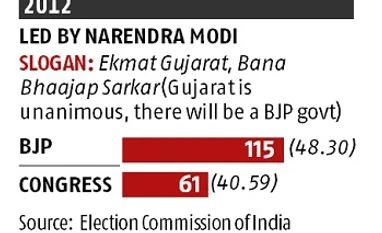 "graph")
graph
The Bharatiya Janata Party (BJP) and the Congress both believe August 8 could, in large part, prefigure the legislative Assembly election in Gujarat, now five months away.
On that day, the state’s legislators will vote in a Rajya Sabha election that will seal the fate of Ahmed Patel, Sonia Gandhi’s political secretary and adjutant for years or the lesser known but locally influential Balwantsinh Rajput. Once, Patel’s protégé, now-turnedchallenger, he’s contesting as an independent, with the BJP’s backing.
The battle has three implications for the BJP, fighting to retain power for the sixth time in Gujarat, described by party veteran L K Advani as the “jewel in our crown”. Seventh, if the short coalition of 1990, when the BJP teamed with the Janata Dal, is counted. State BJP general secretary and spokesperson Bharat Pandya said, “It will be a test of Vaghela’s intrinsic clout.” Shankersinh Vaghela, opposition leader in the Gujarat assembly till last month, was once part of the state BJP’s triumvirate that had Narendra Modi and Keshubhai Patel. He fell out with Modi and Patel, first went solo and eventually joined the Congress.
Vaghela’s assembly constituency, Kapadvanj is in central Gujarat. However, his caste following among the Thakore, as dominant as the Patels in parts, extends to north Gujarat where he damaged the BJP in past elections. In 2012, the BJP won 13 of the area’s 27 seats, while the Congress raised its tally from six to 14. The BJP’s projection was that the Congress could forfeit almost every seat in the northern districts after Vaghela’s exit.
The Rajya Sabha poll is also regarded as a pointer to whether Vaghela still commands the loyalties of the Congress’s Thakore legislators. Third, if Vaghela succeeds and defeats Patel through his kinsman, Rajput, the BJP believes the development could fructify in the formation of a ‘third front’. This would comprise Vaghela’s yet-to-be-born outfit, the Nationalist Congress Party (NCP), whose Rajya Sabha member, Praful Patel, is already campaigning in Gujarat, and a disparate coalition of three young leaders, Hardik Patel (a Patel), Jignesh Mevani (Dalit) and Alpesh Thakore (backward caste), representing irreconcilable caste interests. “Vaghela has hobnobbed with all three. For the BJP, this so-called third front is the best bet to enfeeble the Congress, as it might have exhausted the original card of religious polarisation,” an NCP source said.
Also Read

Navsari MP and Shah aide C R Patil claimed although the Patels voted substantially for the Congress in the panchayat polls of December 2015, they were “passed over” for critical appointments in favour of castes such as the Thakores and Ahirs. “Being anti-BJP doesn’t mean being pro-Congress because in the Congress, one person becomes overly powerful, while we try and balance every grouping, even at the micro tiers,” said Poonam Madaam, an Ahir and MP from Jamnagar. Pandya felt Hardik Patel had lost steam after his “homecoming” from externment last January. “He’s not holding any more rallies,” he said. Central minister Parshottam Rupala, a Patel from Saurashtra’s Amreli, said Hardik’s “practice of wooing the Patel leaders disenchanted with the BJP” had “limitations”. “He’s not a leader,” says Rupala.
A BJP source conceded that after the “shock rout” in the panchayat polls, the government, “monitored” by Shah, adopted “village-targeted correctives”. Such as allowing large farmers to install two, instead of the mandated one, 20 Hp pumps to water their fields, offering interest-free loans, partially underwritten by the Centre, and implementing the SAUNI (Saurashtra Narmada Avtaran Irrigation) Yojana.
Notwithstanding the scepticism on whether the recycled Narmada plank would work again, one of the BJP’s slogans will be ‘Namo Narmadaya, sukho sarvodaya’ (I bow before Narmada, she brings welfare to all). As for the goods and services tax-hit traders, a BJP source’s take was, “They are upset but won’t break away from us. At best, their turnout might be low.” This cautious optimism was not shared in the assessment of which way the votes of youth and first-timers will swing. A Gujarat party functionary said, “Our best bet is to remind these voters of the past, when the state was a laggard. However, two generations of voters have only seen the BJP. If they are negatively disposed towards us, we are in trouble.”
2017
Issues: Patel unrest; discontented traders over GST regime; jobless youths; restive small and medium industrialists; and absence of Modi
Pluses for BJP: Splintered Congress after Vaghela’s exit; robust organisation; 50,000 workers for 48,000 booths (one booth for 250 homes) who have met voters and monitor government schemes; free education for upper castes (after Patel agitation for reservation)
Don't miss the most important news and views of the day. Get them on our Telegram channel
First Published: Aug 07 2017 | 8:43 AM IST