


Politicians grin and bear it
Many have lost significant wealth due to the govt's move but there are no estimates on the extent because of lack of records
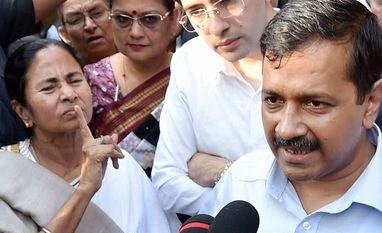 "Delhi Chief Minister Arvind Kejriwal and West Bengal Chief Minister Mamata Banerjee talking to media at a dharna against demonetisation of currency notes, in front of Reserve Bank of India in New Delhi")
Delhi Chief Minister Arvind Kejriwal and West Bengal Chief Minister Mamata Banerjee talking to media at a dharna against demonetisation of currency notes, in front of Reserve Bank of India in New Delhi
The chatter in the political classes is hushed but paradoxically it is also deafening. Many in Parliament have lost significant wealth as a result of demonetisation but no estimates are available because there are no records. A Nationalist Congress Party (NCP) politician in Maharashtra who was a senior minister in the last government is reported to have been ruined. Most of his wealth is in cash in high-denomination notes. Several Maharashtra builders who were close friends of a former chief minister and Union minister also from Maharashtra have lost everything.
In Tamil Nadu, where money flows like water during elections — in the April 2016 Assembly elections, more than Rs 100 crore in cash was seized by the Election Commission, the highest ever in the history of independent India — all political parties are curiously silent about the move. Neither the ruling All India Anna Dravida Munnetra Kazhagam (AIADMK) nor the Dravida Munnetra Kazhagam (DMK) have said much. M Karunanidhi, leader of the DMK only said: “Since it is being said that the move is to eliminate black money, we welcome it. But rather than the rich, only the ordinary, middle and poor people are affected.” This, in a state where cash is king.
Ramgopal Yadav of the Samajwadi Party (SP) said in his speech in Parliament: “It is said that black money finds its way into election funding. But let me place on record, elections are not won or lost on the basis of spending money. If that were the case, the same party would keep winning elections. We win or lose on the basis of the opinions and mandate of the people.”
Really?
No one knows how much cash goes into keeping democracy alive and thriving in India. Consider the reports after the Thirumangalam Assembly byelection in Tamil Nadu in 2009. Anecdotal evidence has it that cash ranging from Rs 1,000 to Rs 5,000 was tucked into morning newspapers with small chits urging people to vote this way or that. The ruling DMK’s imprimatur was most visible, and it won by a margin of an astounding 39,000 votes, leading many to call it a ‘buy’ election. M Karunanidhi’s elder son Azhagiri, who was at the time the DMK strongman in charge of the Madurai region and for him winning Thirumangalam was a matter of prestige, staunchly denied all innuendoes that cash was distributed to win the election. But it is the oracle of our times, the WikiLeaks cables, accessed and published by The Hindu newspaper, that gave the game away. The Hindu published a leaked cable containing a conversation between an official of the US consulate with one Patturajan, whose principal claim to fame was proximity to Azhagiri. Patturajan is quoted to have told the official: “It is no secret at all, Azhagiri (sic) paid Rs 5,000 per voter in Thirumangalam.”

The Tamil Nadu excise department reported a sudden, huge spike in liquor sales from that region. Local media reported how in the week approaching the election butchers were suddenly inundated with customers who would give them Rs 1,000 currency notes, advising them expansively to run a tab. Everyone suddenly seemed to be rich overnight.
Little wonder then, that in the week demonetisation was the biggest political issue in Parliament and outside, all that Tamil Nadu parties were concerned about was the problems faced by fishermen. AIADMK successfully stalled proceedings in both Houses during Zero Hour protesting against attacks on Tamil Nadu fishermen by the Sri Lankan Army. And, in the midst of all his preoccupations, Prime Minister Narendra Modi found time to meet a joint delegation of AIADMK MPs from both Houses of Parliament, which kept him for almost half an hour to apprise him of the contents of a four-page note about the fishermen’s travails.
Who’s talking rollback
The Central Hall of Parliament is the hub of India’s political mood. For two days running, BJP MPs avoided extended discussions on demonetisation and its impact. The first round of debates on November 16, when the Rajya Sabha put aside all other business to discuss the fallout of the decision, saw the government in an extraordinarily complaisant mood. Bitter attacks on the government’s insensitivity in general by the Opposition yielded no impassioned interventions from the Treasury benches, even direct criticism of the prime minister went undefended and unremarked by the BJP. The government was quick to say that it was ready to have a full debate regardless of how long it took. It seemed to be on the defensive.
Interestingly, even before Mamata Banerjee mentioned the word rollback — it was she and Arvind Kejriwal who were the first to demand the government roll back the decision — BJP MPs began asking around if anyone had heard anything about a rollback, asserting staunchly that while there was no question of any such move, “…er…is anyone talking about it?”
If the ruling alliance was confused that there was more to it than just going after black money, so was the Opposition. It took Congress Vice-President Rahul Gandhi nearly 12 hours to decide whether outlawing Rs 1,000 and Rs 500 currency notes was a good idea or a bad one. Even after that, the Congress pointedly stayed away from street protests that were led by Banerjee and Kejriwal. None of its front organisations – the NSUI, the Youth Congress or Seva Dal – came out to pointedly help people in long queues; instead Gandhi made the queues a little longer by opting to join them himself.
Patience running thin
November is the season of investor conferences in Delhi and Mumbai. An investor from a European fund could not believe what he was seeing: Long patient queues of people waiting to withdraw their own money. While the frustration and irritation with the government is evident across the country, almost everybody says in the same breath with ill-suppressed glee that it is the rich who must be suffering much more. There are many critics of the Modi government and a few of Modi himself. The irony is that while those who had very little to start with have even less now, the target of their ire is the bank employee rather than the finance ministry.
Despite indisputable facts – like the rows of trucks carrying perishable goods like vegetables and fruit paralysed for lack of acceptable currency notes, or the speed with which rumours like a shortage of salt spread, or construction labourers having to do with just one meal a day because of delays in payment —demonetisation and its pain is yet to have a quantifiable political backlash. But this is provided the government can limit the damage to the next one week. After that, the damage will begin to show.
New norms, same old paradigm
First Demonetisation
January 12, 1946
Soon after World War II, while the government was giving attention to ways and means of averting the expected slump, thought was also given to check black market operations and tax evasion, which were known to have occurred on a considerable scale. Following the action in several foreign countries, including France, Belgium and the UK, the Government of India decided on demonetisation of high-denomination notes.
It is not known when the government authorities started thinking on the demonetisation measure, but the final consultation with the Governor and Deputy Governor C R Trevor took place towards the end of 1945, when N Sundaresan, joint secretary, ministry of finance, called for a discussion, for which he had earlier prepared a note and the drafts of the Ordinances to implement the scheme. According to a note recorded by Sundaresan, it would appear the Reserve Bank of India (RBI) authorities were not enthusiastic about the scheme. The governor said the finance member had given him the impression that the scheme would be launched only when there were signs of the onset of an inflationary spiral. The governor saw no special signs of such a situation. “It appeared to him that the main object of the scheme was to get hold of the tax-evader. The governor wondered if this could be called an emergency to justify the promulgation of an Ordinance, just before the newly elected Legislative Assembly met. The governor wanted the government to be satisfied that there was no harassment to honest persons. As a currency authority, the bank could not endorse any measure likely to undermine the confidence in the country’s currency.”
The government came out with two Ordinances on January 12, 1946, which was declared a holiday. The first Ordinance asked banks to furnish info about currency holdings of various denominations (Rs 100, Rs 500, Rs 1,000 and Rs 10,000). The second was to tell people that denominations of Rs 500 and above were declared illegal; Rs 100 was spared.
People were given 10 days for exchange. This was later extended to February 9. But, the situation was complex. There was also the issue of princely states. The measure did not succeed, as by the end of 1947, of a total issue of Rs 143.97 crore of the high-denomination notes, notes of the value of Rs 134.9 crore were exchanged. Thus, notes worth only Rs 9.07 crore were probably “demonetised”, not having been presented.
Second Demonetisation
January 16, 1978
Then Finance Minister H M Patel, in his Budget speech on February 28, 1978, said: “The demonetisation of high-denomination banknotes was a step primarily aimed at controlling illegal transactions. It is a part of a series of measures which the government has taken, and is determined to take against anti-social elements.”
R Janakiraman, a senior official in the chief accountant’s office in RBI, got a phone call on January 14, 1978, summoning him to Delhi. On reaching Delhi, he was asked to write the demonetisation Ordinance within 24 hours. He used the previous Ordinance as a guide. On January 16, 1978, All India Radio, in its 9 am news bulletin, announced that an Ordinance had been promulgated.
The Ordinance provided that all banks and government treasuries would be closed on January 17, 1978, for transaction of “all business except the preparation and presentation or the receipt of returns” that were needed to be completed in the context of demonetisation. For purposes of the Negotiable Instruments Act, 1881, January 17, 1978, was deemed to be a public holiday notified under the Act.
People got three days to exchange high-denomination notes. Banks and government treasuries were required to submit information (in the form of data ‘return’) to RBI of high-denomination notes held with them as at the close of business on January 16, 1978.
Long queues started forming in front of the RBI office right from the morning as also at the main office of the State Bank of India, to collect declaration forms. According to press reports on January 18, 1978, the day started with utter confusion over the issue of declaration forms at the RBI headquarters at Bombay and the working hours stretched to 6.30 pm. Enterprising city printers are said to have made quick money selling forms in sets of three for Rs 3.
Governor I G Patel was not in favour of this exercise. Patel recalled in his book, Glimpses of Indian Economic Policy: An Insider’s View, that he told Patel “such an exercise seldom produces striking results. Most people who accept illegal gratification or are otherwise the recipients of black money do not keep their ill-gotten earnings in the form of currency for long. The idea that black money or wealth is held in the form of notes tucked away in suitcases or pillow cases is naïve. And in any case, even those who are caught napping — or waiting — will have the chance to convert the notes through paid agents as some provision has to be made to convert at par notes tendered in small amounts for which explanations cannot be reasonably sought. But the gesture had to be made, and produced much work and little gain”. (p. 159)
Around Rs 73.1 crore was the demonetised amount (from bank notes of Rs 1,000, Rs 5,000 and Rs 10,000) in 1977-78. Compared to this, Rs 1,067 crore was added by Rs 100 alone and the rest of the smaller denominations made up another Rs 650 crore.
(Sources: RBI History, RBI Balance Sheet, RBI Currency and Finance Report)
More From This Section
Don't miss the most important news and views of the day. Get them on our Telegram channel
First Published: Nov 20 2016 | 10:34 PM IST