


India's green startups: A promising selection, but a patchy narrative
One question the authors ask every startup founder in the book is: Imagine your startup as a character from Indian mythology. Who would it be and why?
 "book")
Listen to This Article
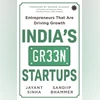
INDIA’S GREEN STARTUPS: Entrepreneurs That Are Driving Growth
Author: Jayant Sinha & Sandiip Bhammer
Publisher: Juggernaut
Pages: 254
Price: Rs 499
Also Read

 "The Green Book: An Observer's Notebook")
 "book")
 "book")
 "Becoming Bangalore: Stories that Shaped a Hometown")
 "BOOK")
The selection process— which they outline in their introduction— is multistage and rigorous. From a very large universe of startups that have green credentials and are building businesses by solving environmental issues, the authors use a number of clear parameters— including total addressable market, climate impact potential, technology and innovation, business model and economics— apart from the founding team’s credentials to winnow it down to the first shortlist.
This is followed by a more active screening phase with even a closer examination of even more parameters to further shorten the list. As a result, one can be sure that the startups that made the final cut are most likely to succeed in the long run and create meaningful impact over the long term. They focus on not just the “green” bit but also on “entrepreneurship” and the necessity to scale up and create a successful impact.
The final list of 14 names is robust. It has some names that have built a strong brand presence in the market already— such as BluSmart and EMotorad. Most of the others are interesting discoveries though some of them have gathered a smattering of press attention from time to time.
The startups cover a fairly diverse number of businesses— from those that are building emission-tracking platforms, to fuel cell manufacturers and researchers, from battery swapping operations to building products from seaweed. And from electric bicycle makers to farmers with a green focus.
Though the selection process may be rigorous, it is the format of the book that lets the reader down. The authors adopted the template of giving a brief introduction about the company/ business followed by an interview with the founder to tell the story of that business. The interviews, though fairly detailed and better than the average interviews that appear in many business publications, tend to meander. Some of the questions asked from each startup founder also leaves one wondering what they add to the overall package for the serious reader trying to understand the products and solutions.
One question the authors ask every startup founder in the book is: Imagine your startup as a character from Indian mythology. Who would it be and why? Another question: If your startup journey was a Bollywood movie, what would be its title and who would you cast as yourself?
In this reviewer’s opinion, these questions are no doubt clever but they tend to detract from the others that are far more serious— such as the total opportunity landscape, the “India only” problem they faced, or even the myth about Indian startups that the founder would like to bust.
The book is an easy read and the examples are all interesting. Despite that, there are a few disappointments. The first is because the authors seem to have spent far more effort on selecting the startups than telling their stories in any detail. In some cases, there is some degree of ambiguity about how much original work the startup actually is doing. For example, while it is clear that one of them, Log9, is working on finding alternate battery chemistry solutions through research and development, it is somewhat less easy to figure out the same about another startup working in the same area. The way the case is presented makes it difficult to figure out whether that startup is primarily an assembly operation or also into serious battery chemistry research. Similarly, it is difficult to understand the Zerocircle case, which has chosen a very interesting area of work— using seaweed— but there aren’t enough details in the book to evaluate its idea properly for the reader.
Then again, all the startups are in very different stages of life but the book does not organise according to either the scale or start-up phase of their life nor with respect to the area in which they are working. They are organised in alphabetical order of names and that ensures that vastly different examples are placed next to each other. So, while BluSmart is a big operation that has been rolled out, another start-up, Accacia, is still trying to significantly impact the real estate area where it is trying to solve the problem of emissions through an AI-driven platform.
In some cases, the area of work the startup is doing— Zero Cow Factory’s work on creating dairy proteins and items without involving bovines or any other animals being one example— is really interesting but the scientific details are scarce, leaving the reader yearning for more.
Overall, the book gives a valuable glimpse of startups working in very interesting areas but it could have been a more substantial body of work with a little bit more effort.
The reviewer is former editor of Businessworld and Business Today magazines and has a keen interest in climate science
More From This Section
 "book")
 "Book")
 "Bill Gates")
 "book")
 "Book Fair")
Topics : BOOK REVIEW Book
Don't miss the most important news and views of the day. Get them on our Telegram channel
First Published: Feb 12 2025 | 11:06 PM IST