


Epochal Budget to Dream Budget: 5 speeches that left an indelible mark
Since the independence of India, several finance ministers have presented Budgets that determined the course of the country's progress. Here are the five Budgets that left an indelible mark on economy
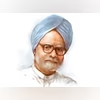 "Manmohan Singh")
ILLUSTRATION: AJAYA MOHANTY


Listen to This Article
Finance Minister Nirmala Sitharaman is set to present the Union Budget on February 1, 2025. Citizens and the industry are expecting lower taxes, higher exemptions, and flexibility in tax rules among other announcements from the Budget.
The Union Budget assumes significance as India’s economy faces a slowdown, with the GDP (Gross Domestic Product) falling to a seven-quarter low of 5.4 per cent in the July-September period.
Since the independence of India, several finance ministers have presented Budgets that changed the course of India’s history. Here are the five Budgets and speeches by finance ministers which left an indelible mark on the country:
India’s first Union Budget, 1947
India’s first Budget as an independent nation was presented on November 26, 1947, by RK Shanmukham Chetty, the country’s first finance minister. Covering the period from August 15, 1947, to March 31, 1948, this Budget addressed the economic challenges of Partition and nation-building.
The estimated revenue was Rs 171 crore, while expenditure stood at Rs 197 crore, leaving a deficit of Rs 26 crore. A significant portion of the Budget focused on the financial strain caused by partition, including the cost of refugee rehabilitation and resource distribution with Pakistan. Shanmukham Chetty emphasised the need for economic stability and growth through rigorous establishment of the rule of law.
Also Read

 "Nirmala Sitharaman, Nirmala")
 "Stock market")
 "telecom")
 "Union Budget, Budget 2024, Budget tablet, Sitharaman, Nirmala Sitharaman")
 "Bahi khata, Budget")
“While we have secured freedom from foreign yoke, mainly through the operation of world vents and partly through a unique act of enlightened self-abnegation on behalf of the erstwhile rulers of the country, we have yet to consolidate into one unified whole the many discordant elements in our national life. This can be achieved only by the rigorous establishment of the rule of law which is the only durable foundation on which the fabric of any democratic State can be raised,” he said.
“If India, just risen from bondage, is to realise her destiny as the leader of Asia and take her place in the front rank of free nations, she would require all the disciplined effort her sons can put forth in the years immediately ahead,” he added.
Carrot and Stick Budget, 1986
In 1986, then Finance Minister VP Singh presented the Budget which came to be known as the ‘Carrot and Stick Budget’. This Budget is considered a pivotal moment in India’s history because it marked the beginning of reforms aimed at liberalising the economy and ending the License Raj.
“My principal priorities in this Budget were to strengthen the public sector, to provide a further thrust to the anti-poverty programmes, to promote self-reliance, and to provide relief to the common man,” said VP Singh, highlighting the essence of the Budget.
One of the key elements of this Budget was the introduction of MODVAT (Modified Value Added Tax) – a system to simplify the excise duty structure. It allowed businesses to claim a credit for taxes paid on inputs, reducing the cascading effect of taxes. Under MODVAT, manufacturers could offset excise duties on raw materials against the final product, helping to lower production costs and improve competitiveness.
Epochal Budget, 1991
In 1991, India faced a severe economic crisis marked by a balance of payments crisis, with dwindling foreign exchange reserves. The country had a high fiscal deficit, slow economic growth, and inflation rates around 12 per cent. Industrial and trade restrictions limited competitiveness, and the financial sector was inefficient, with rising non-performing assets.
At this time, then Finance Minister Dr Manmohan Singh presented the Budget, shifting India from a heavily regulated economy to one embracing market liberalisation. The Budget was known as ‘Epochal Budget’ as Dr Singh introduced three key reforms – liberalisation, privatisation, and globalisation – which opened up the economy.
“This country has honoured me by appointing me to some of the most important public offices of our sovereign Republic. This is a debt which I can never be able to fully repay. The best I can do is to pledge myself to serve our country with utmost sincerity and dedication,” said Dr Singh during his speech.
“The massive social and economic reforms needed to remove the scourge of poverty, ignorance and disease can succeed only if backed by a spirit of high idealism, self-sacrifice and dedication,” he added.
Dream Budget, 1997
In 1997, then Finance Minister P Chidambaram delivered a bold Budget despite a weak United Front government at the Centre. The Budget came to be known as the ‘Dream Budget’ for reducing the tax burden on individuals and companies.
Chidambaram believed that lowering tax rates would boost compliance and hence make more people and corporates pay taxes. He also introduced Voluntary Disclosure of Income Scheme (VDIS), which waived any interest and penalty on late disclosure or other actions under taxation rules.
“Our goal must be to achieve rapid and broad-based growth which alone can ensure higher employment, better living standards and a humane and just society. The challenges that we face today are not unique to India. Other countries, including our friends in Asia, have faced similar challenges. Japan showed the way. Other Asian countries are surging ahead. And, finally, there is the example of China, powering its way to becoming the second-largest economy in the world. These countries have shown that with courage, wisdom and pragmatism they can find their rightful places in the world,” he explained his Budget in a gist.
Millenium Budget, 2000
In the first Budget of the new millennium, then Finance Minister Yashwant Sinha gave a shot in the arm to the Indian IT industry by phasing out Dr Manmohan Singh’s incentive for software exporters.
In his Budget speech, Sinha highlighted the need to “strengthen our role in the world economy through rapid growth of exports, higher foreign investment and prudent external debt management.”
He also emphasised ‘Made in India’. “The millennium has heralded the arrival of the Indian economy on the global stage. In two short years, we have shown that Indian talent and Indian effort is second to none. In two short years, we have ensured that “made in India” is a compliment for any product or service. In two short years, we have sent notice to the world that India will be an economic superpower in the 21st century. The world’s eyes are now upon us, and we will deliver,” he said.
More From This Section
 "Artificial intelligence, AI")
 "Prices of active pharmaceutical ingredients (APIs) have been declining over the past several months, boosting the margins of drug manufacturers. However, many industry insiders attribute this to a predatory pricing strategy by Chinese companies, and")
 "Bonds")
 "Nirmala Sitharaman, Sitharaman")
 "Farmers, Farmer, agriculture")
Topics : Manmohan Singh Budget 2025 Union Budget Budget session Finance minister GDP India GDP BS Web Reports
Don't miss the most important news and views of the day. Get them on our Telegram channel
First Published: Jan 24 2025 | 1:46 PM IST