


$67 bn in 10 years: Japan pledges long-term investment push in India
Modi-Ishiba talks yield 21 outcomes: From defence and critical minerals to high-speed rail and skill training
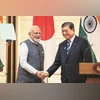 "Narendra Modi, Shigeru Ishiba (Photo: Reuters)")
PM Narendra Modi with his Japanese counterpart Shigeru Ishiba during a press conference in Tokyo (Photo: Reuters)
Listen to This Article
Japan on Friday set a target of 10 trillion yen ($67 billion) in private-sector investments in India over the next decade, as Prime Minister Narendra Modi appealed to Japanese firms to “make in India, make for the world”.
At the 15th India-Japan Annual Summit in Tokyo, Modi and Japanese Prime Minister Shigeru Ishiba announced 21 outcomes, including 13 agreements. The deals span defence cooperation, Japanese investment in critical mineral exploration in India, greater collaboration in semiconductors, further support for expanding India’s high-speed rail network, and training for 50,000 skilled and semi-skilled Indians in Japan.
The two sides endorsed efforts to support Japan Industrial Townships in India and agreed to review the Comprehensive Economic Partnership Agreement to make it more forward-looking. They also pushed for stronger engagement between Indian states and Japanese prefectures.
The engagement will not “remain limited to New Delhi and Tokyo, but deepen through institutional cooperation between Japanese prefectures and states of India, opening new doors,” Modi said.
He will address governors of several prefectures on Saturday. Partnerships already link Andhra Pradesh with Toyama, Tamil Nadu with Ehime, Uttar Pradesh with Yamanashi, and Gujarat with Shizuoka, according to a joint statement.
Also Read

 "Prime Minister Narendra Modi")
 "Modi, Narendra Modi, Shigeru Ishiba")
 "Modi, Narendra Modi")
 "PM Modi")
 "Centre may raise purchase price of cane ethanol by up to Rs 3 per litre")
Asked if US tariffs figured in talks, Indian officials said Modi and Ishiba focused on bilateral issues. Still, sources noted that Tokyo’s commitment to double private-sector investments and its support for India’s semiconductor push comes at a time of turbulence triggered by Washington’s trade policies. Foreign Secretary Vikram Misri said the two countries signed 150 memoranda of understanding (MoUs) worth $13 billion over the past two years.
India has identified small and medium enterprises, and startups for increased Japanese funding. “Special attention” will be given to connecting SMEs and startups in both countries, Modi said.
Among the new deals, Japan’s space agency Jaxa will support India’s Chandrayaan-5 launch. Modi said it will create an ecosystem where innovation flows both ways -- from labs to launch pads, and from research to real-world applications.
On high-speed rail project, the Indian Prime Minister told The Yomiuri Shimbun that the Mumbai-Ahmedabad bullet train will be operational in a few years and that “we have unveiled a bigger ambition: To have a 7,000-kilometre-long network of high-speed rail in our country”.
“I welcome active participation by Japanese companies in this endeavour,” he said.
The joint statement said India appreciates Japan’s offer to introduce the E10 Shinkansen series in the early 2030s. Modi also sought Japanese investments in ports, aviation, shipbuilding, road transport, railways and logistics.
Modi and Ishiba reaffirmed support for a free, open and rules-based Indo-Pacific. Modi said defence and maritime security ties will deepen. “Together, with political trust and natural complementarities, we can design and produce next-generation defence platforms not just for ourselves, but also for the world,” he said.
The Indian leader called for a review of CEPA to unlock its potential and diversify trade. He said India and Japan had “laid a strong foundation for a new and golden chapter in our Special Strategic and Global Partnership. We have set a roadmap for the next decade.”
The two leaders identified three priority areas for cooperation -- “bolstering our defence and security cooperation, reinforcing our economic partnership and deepening our people-to-people exchanges”, the joint statement said.
That 10-year roadmap highlights eight pillars, including economic security, technology and innovation, ecological sustainability, health, and state-prefecture engagement.
A key pact focused on critical mineral supply chains, including joint investments, processing technologies and stockpiling.
Another declaration promoted hydrogen and ammonia projects, while a separate agreement created a joint crediting mechanism.
On security, Modi and Ishiba expressed concern over the East and South China Seas amid growing Chinese assertiveness. They opposed any unilateral actions that endanger the safety as well as freedom of navigation and overflight, and attempt to change the status quo by force or coercion.
They also unequivocally condemned the terrorist attack in Pahalgam and took note of the UN Security Council’s report citing The Resistance Front as responsible.
According to the joint statement, Ishiba urged India to pursue regulatory reforms to help achieve the 10 trillion yen investment target. Modi said he intends to push further reforms to attract Japanese capital and invited more firms to enter India.
The two leaders welcomed the opening of India’s consulate in Fukuoka to strengthen links with the Kyushu region. They also reaffirmed commitment to the Quad grouping, with Modi inviting Ishiba to India for the Quad Leaders’ Summit later this year.
Earlier, Modi met Japanese business leaders and former prime ministers. Speaking with Japanese businesses, he said: "India and Japan's partnership is strategic and smart. Powered by economic logic, we have turned shared interests into shared prosperity." he said.
Describing Japan as a "tech powerhouse" and India as a "talent powerhouse", Modi said the two countries can lead the technology revolution of this century, especially in areas of artificial intelligence, semiconductors, quantum computing, biotech and space.
On Sunday, he and Ishiba will travel by bullet train to Sendai to visit a semiconductor factory.
More From This Section
 "The Department of Expenditure (DoE) in the Ministry of Finance is likely to put out operational framework for implementing the unified pension scheme (UPS). This framework will outline the modalities for various scenarios, including individuals who")
 "GDP")
 "ONGC")
 "Outward remittances fdi dollar currency note")
 "FDI")
Topics : Narendra Modi Japan Investment
Don't miss the most important news and views of the day. Get them on our Telegram channel
First Published: Aug 29 2025 | 10:12 PM IST