


PM Modi's foreign tour aims to boost cooperation in critical minerals
Prime Minister Modi's foreign tour focuses on enhancing cooperation in critical minerals, with key visits to Ghana, Namibia, and Argentina, as India seeks to secure essential resources for its economy
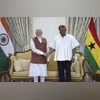 "Prime Minister Narendra Modi with President of Ghana John Dramani Mahama during a meeting, in Accra, Ghana")
Prime Minister Narendra Modi with President of Ghana John Dramani Mahama during a meeting, in Accra, Ghana | (PMO via PTI Photo)
Listen to This Article
Prime Minister Narendra Modi and Ghanaian President John Mahama agreed on Thursday in Accra to double bilateral trade between India and Ghana to $6 billion over the next five years. Officials indicated that a significant portion of the increase would come from India’s imports of Ghanaian critical minerals.
India is one of Ghana’s leading trading partners. Known as the Gold Coast until independence in 1957, Ghana boasts significant gold reserves and other mineral wealth. It maintains a surplus trade balance with India, largely due to the latter’s substantial gold imports, which account for more than 70 per cent of total imports from the West African nation.
Modi and Mahama leaders stressed the need for diversifying the trade basket between their countries.
In the first visit to Ghana by an Indian prime minister in three decades, Modi pledged support for the country’s agriculture and pharmaceutical sectors. “The leaders discussed several other areas of cooperation, but I think I would like to underline here very importantly the idea of cooperation in the area of critical minerals,” said Dammu Ravi, secretary (economic relations) in India’s Ministry of External Affairs (MEA), speaking in Accra.
Also Read

 "Ghana president meets PM Modi")
 "Modi, Narendra Modi")
 "Modi, Narendra Modi")
 "PM Modi in Ghana")
 "Manickam Tagore, Congress MP")
Ghana is just one stop in Modi’s five-nation tour -- his longest overseas trip in a decade -- which focuses heavily on building partnerships for the import and processing of critical minerals, including rare earth elements. Namibia, Argentina, and Brazil -- three of the remaining four destinations (including Trinidad and Tobago) -- are also central to this push. India’s interest is driven by mounting concern over China’s dominance and coercive tactics in the sector, including supply restrictions and price manipulation.
Modi’s current tour marks a rare stretch of eight days abroad. His last trip of comparable duration took place in July 2015, when he visited six nations, including Russia for the Brics summit and five Central Asian republics. His visit to Namibia is the first by an Indian PM in 27 years, and to Argentina, the first in 57 years.
On Wednesday in Accra, Ravi said Mahama had invited Indian investment in the exploration and processing of Ghana’s as yet untapped critical mineral reserves. “We know there are many possibilities here. It requires study. It requires exploration, and then exploitation follows from there,” Ravi said.
At a joint press briefing by Modi and Mahama, the prime minister said Indian companies would cooperate in the exploration and mining of these resources.
In Namibia, Indian investments total around $800 million, primarily in minerals such as zinc and diamond processing. “Namibia is a very resource-rich country. It has natural resources of uranium, copper, cobalt, rare earths in large numbers, lithium, graphite, tantalum, and all of these are of interest to us,” Ravi had stated on Monday. India’s public sector firms, including Khanij Bidesh India Limited (KABIL) and the National Mineral Development Corporation, are actively exploring opportunities across the continent. “In this context, the PM’s visit to both Ghana and Namibia becomes very important,” he added.
P Kumaran, secretary (east) in the MEA, said that Modi’s bilateral visit to Brazil on July 8 will also focus on mining and critical minerals. Modi will be in Argentina on 4 and 5 July. Before departing New Delhi on Wednesday, Modi noted that his discussions with Argentine President Javier Milei would centre on advancing cooperation in energy and critical minerals, among other areas.
Argentina holds the world's second-largest shale gas reserves and the fourth-largest shale oil reserves, along with substantial deposits of conventional oil and gas. It also boasts rich reserves of lithium, copper, and other rare earth elements. Indian public sector firm KABIL has secured a number of concessions in the country since 2024.
Kumaran highlighted that Argentina is part of the so-called Lithium Triangle --alongside Chile and Bolivia -- and that India is in talks with all three nations, as well as Peru, in an effort to acquire mining rights for lithium, molybdenum, and other key resources. Between KABIL and Coal India Limited, Indian PSUs have taken four concessions in Argentina’s Catamarca province. Indian firms are working with CAMYEN, a local provincial PSU, to develop the sites, extract lithium, refine it, and ship it to India. Kumaran added that Indian private companies are also exploring opportunities in Argentina’s rare earth sector.
On Thursday evening, Modi departed Accra for Trinidad and Tobago, the second stop in his five-nation tour.
More From This Section
 "PMI")
 "Vishnu Deo Sai, Chief Minister of Chhattisgarh")
 "India US, India-US")
 "Moody's")
 "US dollar indian rupee")
Topics : Narendra Modi minerals Mining industry
Don't miss the most important news and views of the day. Get them on our Telegram channel
First Published: Jul 03 2025 | 8:10 PM IST