


Keir Starmer's India visit to deepen trade, fintech, and defence ties
UK PM Keir Starmer's two-day India visit will focus on expanding trade under CETA, fintech partnerships, defence cooperation, and higher education links
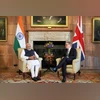 "Britain's Prime Minister Keir Starmer and Prime Minister Narendra Modi")
Britain's Prime Minister Keir Starmer and Indian Prime Minister Narendra Modi | File Photo: Reuters


Listen to This Article
UK Prime Minister Keir Starmer’s two-day visit to India, beginning Wednesday, will build on the “momentum and substance generated by” Prime Minister Narendra Modi’s visit to the UK on July 23–24, India’s Ministry of External Affairs (MEA) said.
On Thursday, Modi and Starmer will attend the sixth edition of the Global Fintech Fest and deliver keynote addresses. The two leaders, along with their delegations, will hold talks in Mumbai and explore ways to build on the Comprehensive Economic and Trade Agreement (CETA), the free trade agreement (FTA) signed on July 24 during Modi’s visit to London.
The two prime ministers will also review ‘Vision 2035’, a 10-year roadmap agreed upon in July, which covers cooperation in sectors such as semiconductors, critical minerals, and defence.
A delegation comprising 100 business leaders, university vice-chancellors, and cultural representatives is accompanying Starmer. The visit also coincides with joint naval exercise Konkan between the two countries’ navies in the Arabian Sea.
Fintech collaboration and new payment settlement system
Also Read

 "Modi, Narendra Modi, Keir Starmer, Keir, Starmer")
 "Modi, Narendra Modi, Keir Starmer, Keir, Starmer, UK")
 "Keir Starmer-Rishi Sunak")
 "Piyush Goyal, Piyush")
On Tuesday, Finance Minister Nirmala Sitharaman launched the Foreign Currency Settlement System (FCSS) of GIFT IFSC at the Global Fintech Festival in Mumbai.
In October 2020, the two countries had established a new UK-India strategic collaboration on GIFT-IFSC, which was reiterated during consultations over the years and at the third India-UK Financial Markets Dialogue held in Gujarat on December 12, 2024.
The FCSS, authorised by the International Financial Services Centres Authority (IFSCA), enables foreign currency transactions between IFSC Banking Units (IBUs) to be settled locally instead of routing through the traditional correspondent banking network.
The system will initially settle transactions in US dollars, with scope to include other foreign currencies later. Standard Chartered Bank (UK), through its IBU, has been selected by CCIL IFSC Ltd as the settlement bank for FCSS, following an open bidding process.
India-UK trade outlook and FTA benefits
Officials said the UK has offered 99.1 per cent of tariff lines with 100 per cent trade value at zero duty immediately upon the FTA’s enforcement.
New Delhi expects tangible gains from synergies in trade, investment, technology, innovation, mobility, and education. The agreement is India’s most comprehensive FTA, covering 26 chapters.
Bilateral trade in goods and services stood at around $56 billion in 2024, with a target to double this by 2030.
India expects the CETA to boost its exports in labour-intensive sectors such as textiles, gems and jewellery, engineering goods, auto parts, and engines. The pact also supports growth in IT and ITeS, financial and professional services, education, and business services.
The ‘double contributions convention’ provides a three-year exemption from UK social security contributions for eligible Indian workers on temporary assignments, benefiting an estimated 75,000 workers.
The agreement also establishes mechanisms to address non-tariff barriers.
Expanding cooperation in health, education, and aviation
In the health sector, the two countries signed an agreement in July 2022 to support the recruitment and training of nurses and allied health professionals.
According to UK government data, by June 2023, out of 1.51 million NHS staff, 60,533 were from India — including 31,992 nurses and 11,499 clinical support staff.
In education and skill development, nearly 3,000 young professionals from each country can live and work in the other for up to two years.
Queen’s University Belfast is expected to start academic classes at its international branch campus in GIFT IFSC from January 2026. The University of Surrey’s GIFT IFSC campus is expected to begin operations in the second half of 2026.
Indian and British companies together employ over 650,000 people in each other’s countries. India also opened new consulates in Manchester and Belfast in March 2025.
The FTA is set to boost air connectivity between the two nations. Virgin Atlantic has been operating a daily London–Bengaluru service since March 2024. British Airways added a new daily Delhi–London flight from April 2025, while IndiGo will start Delhi–Manchester flights from November 15.
British Airways CEO Sean Doyle, part of Starmer’s delegation, wrote in The Sunday Times about plans to expand the airline’s India operations, calling aviation a “critical enabler of UK-India trade.”
More From This Section
 "GDP, India GDP")
 "rbi, reserve bank of india")
 "oil")
 "GST")
 "Nirmala Sitharaman, Nirmala")
Don't miss the most important news and views of the day. Get them on our Telegram channel
First Published: Oct 07 2025 | 9:42 PM IST