


After Tarique Rahman's Bangladesh election win, what changes for India now
Tarique Rahman's decisive win marks a political reset in Bangladesh after months of turmoil and India is now closely watching how the new leadership approaches security, trade and regional alignments
 "Bangladesh elections")
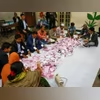
Bangladesh voted in parliamentary elections and a referendum on the July National Charter 2025, nearly 18 months after the 2024 upheaval. (Photo: Reuters)
Listen to This Article
Bangladesh’s latest general election, the first since the violent unrest of July 2024 that ended Sheikh Hasina’s long rule, is set to deliver a decisive mandate to the Bangladesh Nationalist Party (BNP) led by Tarique Rahman. The outcome marks a sharp political turn in Dhaka and presents an opportunity for New Delhi to recalibrate ties with a neighbour that had been one of its closest regional partners for decades.
Rahman’s victory also completes a dramatic personal comeback. The 60-year-old son of former president Ziaur Rahman and former prime minister Khaleda Zia returned to Bangladesh after nearly 17 years in exile following his mother’s death in December 2025. The Awami League, led by Sheikh Hasina, could not contest the election after its registration was suspended, leaving the BNP as the dominant force.
Who is Tarique Rahman and how did he return to power?
Tarique Rahman is the eldest son of Khaleda Zia, who led Bangladesh three times as prime minister. Rahman formally took over as BNP chairman in December 2025, having earlier served as acting chairman while in exile.
Rahman has long been a polarising figure. During the BNP-led coalition government between 2001 and 2006, he was widely described as the party’s de facto power centre, operating from Hawa Bhaban, often referred to in Bangladeshi political discourse as a “shadow PMO”.
His return to Dhaka last year was marked by large public rallies and a campaign focused on political change after the collapse of the Hasina government in mid-2024.
Also Read

 "strength training study")
 "truck")
 "Supreme Court, SC")
 "money, financial, cash, rupee")
 "Mustafa Suleyman")
How did India respond to the election outcome?
India moved quickly to engage the new leadership. Prime Minister Narendra Modi congratulated Rahman on his win, saying the result reflected “the trust of the people of Bangladesh” in his leadership.
"I convey my warm congratulations to Mr Tarique Rahman on leading the BNP to a decisive victory in the parliamentary elections in Bangladesh," PM Modi said in a post on X.
He added that India would continue to support a “democratic, progressive and inclusive Bangladesh” and expressed hope of working closely with the new government to strengthen bilateral relations and advance shared development goals.
The early outreach was seen by political analysts as an effort by New Delhi to establish lines of communication before China or Pakistan could shape Dhaka’s external engagements.
Why is India watching Bangladesh’s foreign policy so closely?
India has followed the Bangladesh election closely because changes in Dhaka can have direct consequences for regional geopolitics and India’s internal security. Under Sheikh Hasina, India and Bangladesh enjoyed one of their most stable periods of cooperation, spanning trade, transit, border management and security coordination.
India’s main concern now is whether a Rahman-led government adopts a posture less aligned with Delhi’s interests. Of particular interest is the risk of Bangladesh moving closer to Pakistan and China, potentially altering regional power balances in South Asia.
The concern shown by Pakistan in the ongoing men’s T20 World Cup for Bangladesh has raised eyebrows and given New Delhi a few things to ponder over.
However, with Rahman’s victory, that concern may ease to some extent because the BNP is set to form the government without Jamaat-e-Islami as a coalition partner. New Delhi has traditionally viewed Jamaat’s participation in government as destabilising for bilateral ties.
China’s presence in Bangladesh, however, remains significant through large infrastructure projects, including port modernisation. Indian analysts have consistently flagged these projects for their potential strategic implications in the Bay of Bengal.
What are the concerns on borders and internal security?
India and Bangladesh share a 4,100-kilometre border that runs through densely populated and politically sensitive regions. Border management and illegal migration have become key political issues, especially with Assembly elections due this year in West Bengal and Assam.
Under Hasina, Dhaka was seen as more willing to cooperate on curbing illegal crossings and tackling cross-border crime. But Indian agencies say infiltration attempts have risen since her fall in July 2024.
Therefore, how firmly Rahman’s government acts on border control, drug smuggling and cross-border violence will shape New Delhi’s assessment of the new dispensation.
Why does the Hindu minority issue matter to India?
After Hasina was deposed, attacks on Hindus (which make up about 8 per cent of the country’s population) in Bangladesh have increased, with India saying at least 23 Hindus have been killed since then.
While Bangladesh’s interim administration, led by Muhammad Yunus, acknowledged deaths and violence, it said many incidents stemmed from non-communal disputes. India, however, has publicly raised concerns and called for stronger protection measures for minorities.
On that front, Rahman has promised security for all communities, but Indian officials are likely to track ground-level outcomes closely, given the BNP’s past associations with conservative political elements.
How important is trade in the India-Bangladesh relationship?
Trade remains a stabilising factor. Bilateral trade stands at about $13-14 billion annually, with India running a surplus of nearly $9-9.5 billion in FY24 and FY25.
Bangladesh depends heavily on Indian cotton yarn, which accounts for more than 80 per cent of its imports for the readymade garments sector, a backbone of its economy.
While Dhaka could seek supplier diversification, analysts say the new government is unlikely to disrupt supply chains immediately, especially as it looks to restore economic stability after months of political upheaval.
More From This Section
 "Rafale, Aircraft")
 "IAF, Indian Air Force, Fighter plane")
 "India US trade deal")
 "Rajnath Singh")
 "Defence")
Don't miss the most important news and views of the day. Get them on our Telegram channel
First Published: Feb 13 2026 | 1:59 PM IST