


China used India-Pak conflict as 'live lab' to test weapons: Lt Gen Singh
Lt Gen Rahul Singh reveals China backed Pakistan during May conflict, calling it a 'live lab' for weapons. He urges stronger air defence, noting support from Turkiye and China's key military role
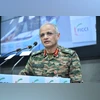 "Lt Gen Rahul R Singh")
Lt Gen Rahul R Singh said that China was using Pakistan as a tool to inflict harm on India during the four-day conflict in May. | Credit: X@Ficci
Listen to This Article
Pakistan was in the front, and China was providing all possible support during military conflict in May, said Lieutenant General Rahul R Singh on Friday.
Speaking at an event titled ‘New Age Military Technologies’ hosted by Ficci, the Deputy Chief of Army Staff (Capability Development & Sustenance), Lieutenant General Singh, spoke about the recent military conflict between India and Pakistan. He explained how the situation was more complex than it seemed on the surface.
“Air defence and how it panned out during the entire operation was important... This time, our population centres were not quite addressed, but next time, we need to be prepared for that... We had one border and two adversaries, actually three. Pakistan was in the front. China was providing all possible support. 81% of the military hardware with Pakistan is Chinese... China is able to test its weapons against other weapons, so it’s like a live lab available to them. Turkey also played an important role in providing the type of support it did... When DGMO-level talks were on, Pakistan had the live updates of our important vectors, from China... We need a robust air defence system,” said Lt Gen Singh, according to an ANI tweet.
Also Read

 "India Pakistan, India, Pakistan")
 "Pakistan Army Chief General Asim Munir")
 "satellite rocket space")
 "Metal debris, missile, operation sindoor")
 "Maritime fund may set sail with foreign kitty, PSU push, boat, ship, cargo")
#WATCH | Delhi: At the event 'New Age Military Technologies' organised by FICCI, Deputy Chief of Army Staff (Capability Development & Sustenance), Lt Gen Rahul R Singh says, "Air defence and how it panned out during the entire operation was important... This time, our population… pic.twitter.com/uF2uXo7yJm
— ANI (@ANI) July 4, 2025
China’s 'borrowed knife' strategy
Lt Gen Singh said that China was using Pakistan as a tool to inflict harm on India during the four-day conflict in May. He added that Beijing’s support to Islamabad was in line with an old Chinese military principle.
He referred to the “36 stratagems” from ancient Chinese warfare theory, which includes the idea of “killing with a borrowed knife” — essentially using someone else to carry out hostile acts.
“He (China) would rather use the neighbour to cause pain (to India) than getting involved in a mudslinging match on the northern border,” Lt Gen Singh said. He pointed out that China’s involvement was not unexpected given that the majority of Pakistan’s defence equipment comes from China.
“Pakistan was the front face. We had China providing all possible support. And there was no surprise because, if you look at the statistics in the last five years, 81 per cent of the military hardware that Pakistan is getting is all Chinese,” he said.
Turkiye's involvement
The Deputy Chief also spoke about the role of Turkiye in supporting Pakistan’s military efforts during the conflict. “We saw numerous drones coming and landing in the face of war, during the war, along with the individuals who were there,” he said.
Lt Gen Singh also highlighted that India’s leadership sent a strong and clear strategic message during the confrontation. The military’s decisions, especially target selection in Pakistan and Pakistan-occupied Kashmir (PoK), were made using detailed data analysis.
Operation Sindoor
India had launched Operation Sindoor on May 7 in response to a terrorist attack in Pahalgam on April 22. The mission targeted terror bases across the border.
The action led to four days of heavy cross-border hostilities, ending on May 10 after both sides reached an understanding to halt military actions. Significantly, Pakistan sought an end to the clashes following India’s forceful counter-strike.
More From This Section
 "Rajnath Singh")
 "The artificial intelligence (AI) market in India is expected to clock a compound annual growth rate of 25-35 per cent by 2027, matching a global trend of the technology's expansion. The Indian market is worth $7-10 billion now and it is expected to r")
 "drones, millitary, army")
 "Jaishankar fake news")
 "Fishermen, Indian fishermen")
Topics : India Pakistan relations China Operation Sindoor Indian Army air defence Turkey India weapons BS Web Reports
Don't miss the most important news and views of the day. Get them on our Telegram channel
First Published: Jul 04 2025 | 6:12 PM IST