


Fresh Agni-IV test proves operational readiness: Defence Ministry
India successfully test-fired the nuclear-capable Agni-IV ballistic missile off the Odisha coast, validating its operational readiness and technical parameters under the Strategic Forces Command
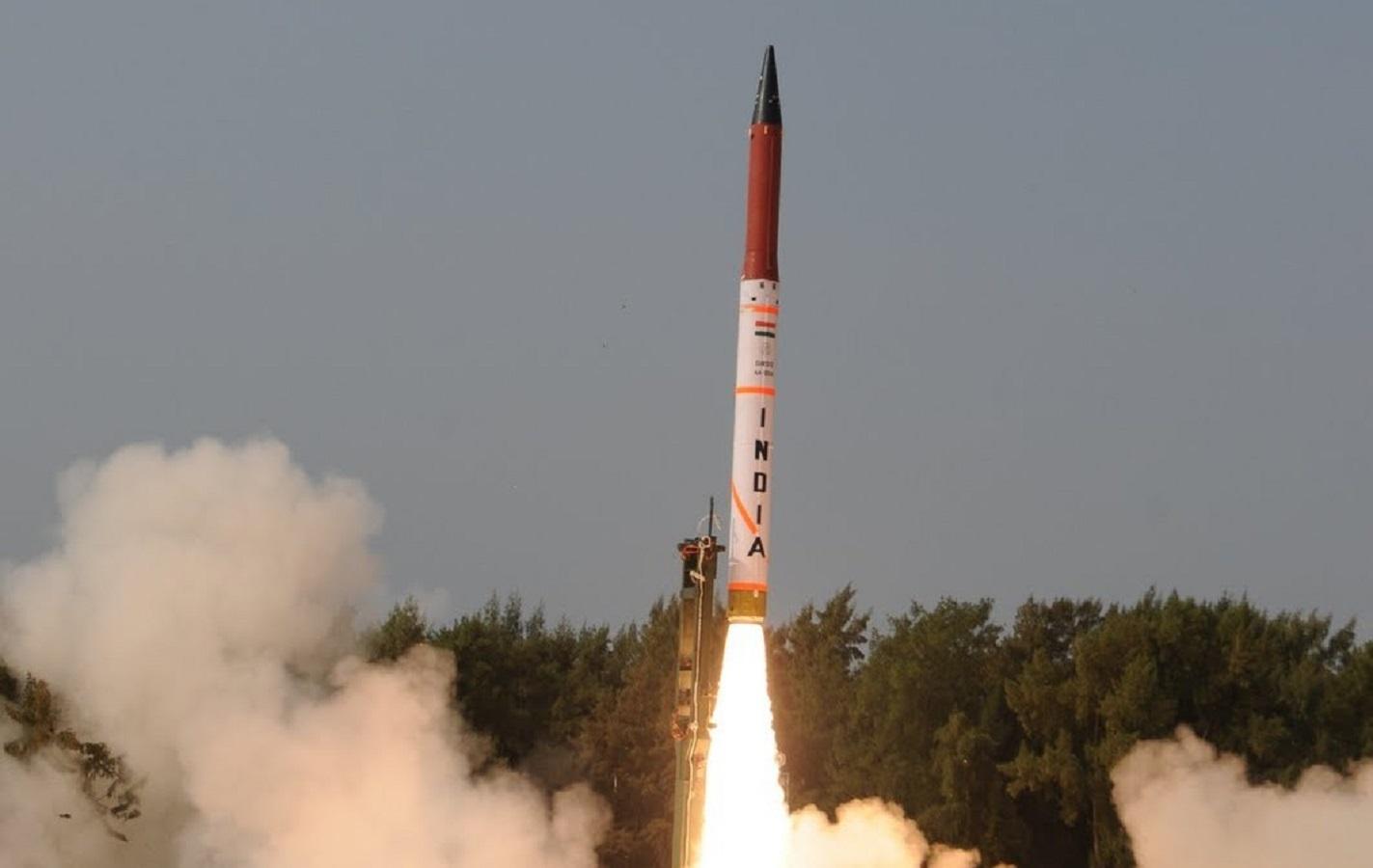 "Agni-IV missile being test-fired from Abdul Kalam Island off the Odisha coast (File photo: DRDO)")
Agni-IV missile being test-fired from Abdul Kalam Island off the Odisha coast (File photo: DRDO)
Listen to This Article
Amid heightened geopolitical tensions and a rapidly changing strategic environment, India on Thursday carried out a fresh flight test of its nuclear-capable intermediate-range ballistic missile (IRBM), Agni-IV, from a defence facility off the Odisha coast.
Defence sources said the evening test of the 4,000-km-range missile was conducted from Abdul Kalam Island by the Strategic Forces Command (SFC), which oversees the strategic nuclear arsenal of the Indian Army. The test validated all operational and technical parameters of the weapon system.
"The missile was test-fired from a mobile launcher with logistics support from DRDO. The missile was randomly selected from a production lot. The trial was to examine the missile's operational readiness under different conditions," sources said.
The test assumes significance as India steadily expands and modernises its strategic missile capabilities amid rapid developments in long-range missile systems in the region. The focus is on ensuring that the weapons are mobile, difficult to detect and capable of being deployed at short notice.
"Agni-IV was successfully test-fired from the Integrated Test Range, Chandipur, in Odisha on August 6. The launch validated all operational and technical parameters. The test was carried out under the aegis of the Strategic Forces Command," the Ministry of Defence said in a statement.

 "turbojet engine india")
 "Indigenously developed LRSAM Kusha being test-fired from Abdul Kalam Island off the Odisha coast on Thursday. (Photo: DRDO)")
 "Titanium components for light weight tank")
 "Supersonic Missile-Assisted Release of Torpedo system successfully tested on May 1, 2024, from Dr APJ Abdul Kalam Island off the coast of Odisha. Photo: PIB")
 "The ULPGM is a family of indigenous “fire-and-forget” precision strike weapons. Photo: PIB")
The Agni-IV is among India's most advanced long-range ballistic missiles and can be operated from a self-contained mobile launcher. Its road-mobile configuration allows the missile to be dispersed and moved between locations, making it considerably harder for an adversary to identify and target the system before launch.
According to defence experts, the credibility of a nuclear deterrent depends not only on possessing nuclear weapons but also on having delivery systems that can survive an initial attack and remain available for retaliation. The latest test is significant for the operational reliability of the Agni-IV, which complements India's medium-range and longer-range strategic missile systems, they said.
The Agni family has evolved considerably over the years. The Agni-I and Agni-II provide shorter-range capabilities, while Agni-III and Agni-IV extend India's reach deeper into the Asian strategic theatre. The Agni-V, with a reported range of over 5,000 km, provides an even longer-range capability.
Agni-IV can be compared with China's DF-26 road-mobile ballistic missile. India is also introducing newer-generation systems such as Agni-Prime, which has a strike range of up to 2,000 km with greater mobility and newer technologies.
"The missile uses a composite rocket motor and is made of lightweight composites. A high-accuracy ring-laser gyroscope-based inertial navigation system, a micro-navigation system, a digital controller system and a very powerful onboard computer system make it a unique weapon system in its class," said a defence scientist.
The 20-metre-long missile, with a diameter of 1.3 metres, weighs around 17 tonnes. It can carry payloads of around 1,000 kg. The missile reached the target and destroyed it with high accuracy during the test. It has been inducted into the armed forces.
More From This Section
 "Fishermen, Indian fishermen")
 "Security, Manipur Security")
 "Brics, BRICS")
 "Piyush Goyal, Piyush, Manthan 2026, Manthan")
 "Donald Trump,Trump")
Don't miss the most important news and views of the day. Get them on our Telegram channel
First Published: Aug 06 2026 | 9:51 PM IST