


India, Cyprus unite on sovereignty, seek peace amid rising global strain
PM Narendra Modi became the first Indian PM to visit Cyprus in over two decades; honoured with the Grand Cross of the Order of Makarios III for strengthening bilateral relations
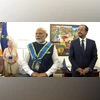 "PM Modi receives Cyprus' top honour")
PM Modi receives Cyprus’ top civilian honour, Order of Makarios III, during his visit. (Photo: X/BJP4India)
Listen to This Article
Prime Minister Narendra Modi and Cyprus President Nikos Christodoulides reaffirmed their commitment to respecting each other’s sovereignty and territorial integrity during Modi’s two-day visit to Cyprus from June 15–16. Amid global geopolitical tensions, both leaders emphasised the importance of upholding international law, including the UN Charter and the United Nations Convention on the Law of the Sea (UNCLOS), and called for the peaceful resolution of conflicts.
Prime Minister Narendra Modi’s visit marked the first by an Indian Prime Minister to Cyprus in 23 years as a part of his three-nation tour, which includes stops in Croatia and Canada, where he is scheduled to attend the G7 Summit. On Monday, Cyprus conferred its highest civilian honour — the Grand Cross of the Order of Makarios III — on PM Modi in recognition of his contributions to strengthening bilateral ties.
This is PM Modi’s first foreign visit following ‘Operation Sindoor’, which targeted terror camps in Pakistan and Pakistan-occupied Kashmir on May 7.
PM Modi in Cyprus: Focus on economic cooperation, investment
At a business meeting in Limassol, Modi highlighted India’s growing economic stature as the world’s fifth-largest economy and invited Cypriot businesses to invest in sectors like infrastructure, digital payments, AI, manufacturing, and green energy. Calling Cyprus a “reliable partner”, he stressed the importance of closer commercial cooperation and innovation partnerships. Both leaders reaffirmed their “unwavering support for the sovereignty and territorial integrity of all nations”, a key message amid ongoing geopolitical challenges.
Also Read

 "Modi, Narendra Modi")
 "PM Modi receives Cyprus' top honour")
 "PM Modi with Cyprus President")
 "PM Modi at Invest Cyprus")
 "PM Modi in Cyprus")
This message holds special importance given Cyprus’ ongoing conflict with Turkiye, where questions about control of land and sea areas have remained unresolved for decades.
Cyprus- Turkiye conflict
Cyprus and Turkiye have a long-running territorial dispute that began after Turkiye invaded northern Cyprus in 1974, following a coup aimed at uniting the island with Greece. Since then, Cyprus has been divided, with the northern part controlled by a Turkish-backed administration, recognised only by Turkiye.
Tensions persist over territorial waters and energy resources. Turkiye disputes Cyprus’ exclusive economic zone (EEZ) claims, objecting to offshore drilling and asserting overlapping rights, particularly in areas with significant gas reserves. Diplomatic efforts continue, but a resolution remains elusive as both sides hold firm to their positions.
India-Cyprus relationship: Strengthening ties across sectors
India and Cyprus agreed to institutionalise regular political dialogue through their foreign ministries and reaffirmed commitment to a peaceful, UN-led resolution to the Cyprus issue based on a bi-zonal, bi-communal federation. Both sides emphasised avoiding unilateral actions and fostering conditions for meaningful negotiations.
On security, the leaders condemned all forms of terrorism and expressed zero tolerance for cross-border threats. Cyprus strongly supported India after the recent terror attacks in Jammu and Kashmir. They called for dismantling terror networks, cutting off financing, and expediting a global convention against terrorism. Defence ties between the nations will deepen, focusing on cybersecurity, maritime security, and crisis response.
The leaders endorsed the India–Middle East–Europe Economic Corridor, with Cyprus offering to serve as a regional logistics hub. Both countries also pledged to boost trade, innovation, and research collaboration.
They plan to enhance tourism, finalise a mobility programme by 2025, and implement a five-year Action Plan to guide future cooperation.
More From This Section
 "S Jaishankar, Jaishankar, Mohamed bin Zayed Al Nahyan, UAE President")
 "Weapons, Nuclear weapons")
 "PM Modi")
 "Ryal Navy F-35B")
 "Emigration, immigration, jobs abroad, indian students abroad")
Don't miss the most important news and views of the day. Get them on our Telegram channel
First Published: Jun 16 2025 | 5:29 PM IST