


India engaging with US on Chabahar port sanctions waiver, says MEA
Given the rapid developments in US-Iran tensions and India's own strategic interests in the port, experts believe India will have to walk a tightrope on the issue for the foreseeable future
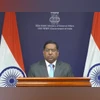 "Ministry of External Affairs (MEA) spokesperson Randhir Jaiswal")
Ministry of External Affairs (MEA) spokesperson Randhir Jaiswal addressed a press conference on Friday.
Listen to This Article
The ministry of external affairs (MEA) on Friday said it is engaging with the United States (US) on the sanctions waiver for the port amid concerns over the long-term viability of the strategically important Chabahar Port in Iran.
“As you are aware, on October 28, 2025, the US Department of Treasury had issued a letter outlining the guidance on the conditional sanctions waiver valid till April 26, 2026. We remain engaged with the US in working out this arrangement,” the ministry’s spokesperson Randhir Jaiswal said.
This comes as concerns were raised over India’s involvement in the port after US President Donald Trump announced additional tariffs on countries involved in business with Iran.
“Effective immediately, any country doing business with the Islamic Republic of Iran will pay a tariff of 25 per cent on any and all business being done with the United States of America. This order is final and conclusive…,” Trump said in a social media post earlier this week.
In 2024, the Shahid Beheshti Terminal – one of the two terminals at the Chabahar Port – had received a fresh lease of life after India had inked a long-term contract for the operation of the port with Iran, with investment commitments worth $370 million -- comrising a $120 million direct investment and a $250 million line of credit.
Also Read

 "Ministry of External Affairs (MEA) spokesperson Randhir Jaiswal")
 "Iran, Iran protest")
 "S Jaishankar, Jaishankar")
 "Mohammad Fathali, Iran's ambassador in India")
However, the US, amid rising tensions with Iran over its nuclear programme, and an impasse with India over the proposed trade deal, delivered a major blow to India’s strategic ambitions last year.
In September 2025, the US Secretary of State had revoked the sanctions exception issued in 2018 under the Iran Freedom and Counter-Proliferation Act (IFCA) for Afghanistan reconstruction assistance and economic development, effective September 29.
“Once the revocation is effective, persons who operate the Chabahar Port or engage in other activities described in IFCA may expose themselves to sanctions under IFCA,” the statement said.
In October, the conditional waiver referred to by Jaiswal was given by the US. India considers its presence in the port strategically important, given its close proximity to Pakistan and Chinese investments in Pakistan’s Gwadar Port.
Given the rapid developments on US-Iran tensions and India’s own strategic interests in the port, experts believe that India would have to walk a tightrope on the issue for the foreseeable future.
“Chabahar, at this point, is hostage to what is happening in Iran. There is enough challenge internally for the Iranian government to be able to coherently think about any such forward looking project. Between both US-India and the US-Iran, we will have to wait and watch. I don't think there is much that India can do at this juncture,” said Harsh Pant, vice-president at think tank Observer Research Foundation.
Iran is going through a major period of unrest, with protests across the country and over 3000 reported arrests.
The port was a point of emphasis by Prime Minister Narendra Modi at the much-discussed SCO Summit last September.
“India has always believed that strong connectivity does not merely facilitate trade but also opens the doors to trust and development. It is with this vision that we are working on initiatives such as the Chabahar Port and the International North-South Transport Corridor. Through these, we can enhance our linkages with Afghanistan and Central Asia,” Modi had said in China.
Pant added that with trade volumes through the port minimal on the commercial front, business impact right now would not be the primary priority for India.
However, with a lack of transit access for goods through Pakistan, prospects of seamless commercial connectivity to Central Asian countries have for long hinged on the stable operations of the port, a government official said.
It is a critical gateway for the proposed International North-South Transport Corridor (INSTC) — a multi-modal route between India, Central Asia and Russia, reducing transit time for trade between the three regions.
“Strategic interest has been the key driver of Chabahar negotiations. India’s stance on that had been well understood by Washington through the Obama and Biden era, which had effected multiple waivers in the past. Whether Trump chooses to agree with that rationale is an open question,” said Pant.
Ultimately, the project would be economically sustainable only if Iran is able to normalise its ties with the rest of the world, he added.
New
More From This Section
 "S Jaishankar, Jaishankar, Toshimitsu Motegi")
 "defence budget, national security")
 "Republic Day rehearsal, Republic Day")
 "Premier engineering concern Bharat Forge has broadened its revenue streams by entering new non-auto segments and markets, resulting in the share of the auto business dropping to 58 per cent in the financial year 2024 (FY24) from 80 per cent (FY07). I")
 "def, soldiers, armed forces")
Don't miss the most important news and views of the day. Get them on our Telegram channel
First Published: Jan 16 2026 | 8:59 PM IST