


MHA orders civil defence drills amid escalating tensions with Pakistan
The exercise will be conducted in 244 'civil defence districts' on Wednesday
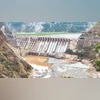 "Salal Dam on the Chenab river in Reasi district of J&K on Monday. Water levels in the river have dropped sharply after its flow was restricted through Baglihar and Salal dams, days after India suspended Indus Waters Treaty with Pakistan | photo: pti")
Salal Dam on the Chenab river in Reasi district of J&K on Monday. Water levels in the river have dropped sharply after its flow was restricted through Baglihar and Salal dams, days after India suspended Indus Waters Treaty with Pakistan | photo: pti
Listen to This Article
Amid escalating tensions with Pakistan, the Ministry of Home Affairs (MHA) on Monday asked several states to conduct mock drills on Wednesday — such as operationalising air-raid warning sirens and training civilians on civil defence to protect themselves in the event of a “hostile attack”.
The drills include organising a civil-defence exercise and rehearsal across 244 categorised “civil defence districts” in the country.
There will be provisions for crash blackout measures, quickly camouflaging vital plants, and installing and updating evacuation plans.
The ministry said the exercise was planned up to village level and aimed to assess and enhance the readiness of civil-defence mechanisms across all states and Union Territories. The exercise will see the involvement of district authorities, Home Guards, National Cadet Corps, college and school students.
Such a large-scale mock drill will be taking place for the first time since the 1971 Bangladesh war, experts said.
Also Read

 "Flight, plane, Airplane")
 "Earthquake")
 "Pakistani singer, Abida Parveen")
 "Russian Foreign Minister Sergei Lavrov speaks at a press conference, during the G20 summit, in New Delhi, Photo: Reuters")
 "Parameswaran Iyer")
The MHA advisory came on a day of hectic developments marked by key meetings that Prime Minister Narendra Modi had. One meeting was with Defence Secretary Rajesh Kumar Singh, who is understood to have briefed him about the combat readiness of the armed forces.
Chief of Air Staff Air Chief Marshal A P Singh and Navy Chief Admiral Dinesh K Tripathi had met the Prime Minister on Sunday and Saturday, respectively.
During the course of the day, Iranian Foreign Minister Abbas Araghchi, on a visit to Islamabad, before he lands in New Delhi later in the day, urged the two neighbours to reduce tensions.
In a talk with Modi on the phone, Russian President Vladimir Putin backed India’s fight against terror, expressed condolences for the killing of 26 people in the terror attack in Pahalgam on April 22, and confirmed that he would visit India later this year for the annual bilateral summit.
Speaking to the media at the United Nations (UN) headquarters in New York, UN Secretary General António Guterres said it pained him to see relations between India and Pakistan reaching a boiling point. He said he understood the “raw feelings” that the Pahalgam terror attack had caused.
“It is also essential, especially at this critical hour, to avoid a military confrontation that could easily spin out of control,” Guterres said.
“Now is the time for maximum restraint and stepping back from the brink,” he said, adding that “a military solution is no solution”. He also offered his “good offices” to the two governments “in the service of peace”.
According to a PTI report from Jammu, the Jammu and Kashmir Police on Monday warned people against crossing the Chenab on foot in Jammu’s Akhnoor sector after the river recorded its lowest water discharge and attracted hundreds of villagers, some of whom were seen searching for gold and silver ornaments, and coins. The drop in water level was attributed to the river’s flow being restricted through the Baglihar and the Salal dams in Ramban and Reasi districts, officials said.
According to a Reuters report, after announcing the suspension of the Indus Waters Treaty on April 23, India began work to boost the reservoir-holding capacity of the Salal and Baglihar dams.
In another key development, amid attempts to hack multiple Indian websites, sources said “appropriate and necessary measures” to “bolster” cybersecurity infrastructure, “strengthen digital defence” mechanisms to safeguard against further “intrusion attempts” had been taken.
However, officials rejected social media claims that the website of the Manohar Parrikar Institute for Defence Studies and Analyses, a Delhi-based think tank, had been “hacked”.
At least four Army Public Schools (APS), including APS Nagrota and APS Sunjuwan, both located in Jammu and Kashmir, were targeted by hackers, a source said.
The website of the Armoured Vehicle Nigam Ltd (AVNL), a public-sector enterprise under the Ministry of Defence, was taken offline, in a precautionary measure. Indian cyber agencies thwarted an attempt by a Pakistan-based hacking group to deface it, sources said.
The mock drill notification came after Islamabad’s envoy to Moscow, Muhammad Khalid Jamali, had told Russia’s state-run TASS news agency on Sunday that Pakistan would respond with “full spectrum of force, both conventional and nuclear” if it was attacked or its vital water flow disrupted.
However, he urged the need to reduce tensions because the two neighbours were nuclear powers.
Pakistan on Monday conducted a training launch of the “Fatah series” surface-to-surface missile with a range of 120 kilometres. The Inter-Services Public Relations (ISPR), the media wing of the army, said in a statement that a “Fatah Series” was tested as a part of the ongoing exercise “INDUS”.
Defence Minister Rajnath Singh on Monday hosted his Japanese counterpart Gen Nakatani for wide-ranging talks touching upon the scourge of terrorism and ways to expand bilateral defence ties in the wake of China’s military posturing in the Indo-Pacific.
In its commentary titled “Escalating Pakistan-India tensions would weigh on Pakistan's growth”, Moody’s Ratings on Monday said tensions between the two countries would not have any major economic disruption in India, but would be a setback for Islamabad.
According to state-run Radio Pakistan, the Chinese ambassador to Islamabad, Jiang Zaidong, said on Monday as he met President Asif Ali Zardari that China would always support Pakistan to secure peace and stability in South Asia.
More From This Section
 "India's Multi-Influence Ground Mine (MIGM)")
 "Army, Soilder, Kathua")
 "India-Pakistan")
 "India Pakistan")
 "United Nations Security Council")
Topics : Pakistan Pahalgam attack Terror Alert
Don't miss the most important news and views of the day. Get them on our Telegram channel
First Published: May 05 2025 | 10:26 PM IST