


Pahalgam attack: Pakistan warns of 'all-out war', vows measured response
On April 22, terrorists launched an attack in Pahalgam, Jammu and Kashmir, killing 26 and injuring over a dozen tourists at the Baisaran meadow, triggering national outrage and calls for action
 "Pahalgam Security, Pahalgam, terrorist attack")
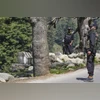
Security personnel stand guard in Pahalgam, Jammu and Kashmir. (Photo: PTI)
Listen to This Article
Defence Minister of Pakistan Khawaja Asif has said that the country’s military is “prepared for any eventuality” as tensions with India increase following a terror attack in Jammu and Kashmir’s Pahalgam. The attack, which occurred earlier this week, claimed the lives of 26 people.
Speaking to Sky News, Asif said the deteriorating relations between India and Pakistan after the April 22 Pahalgam attack could potentially escalate into a full-scale war. “We will measure our response to whatever is initiated by India. It would be a measured response,” he said in the interview.
He further warned that any large-scale offensive could trigger a broader conflict. “If there is an all-out attack or something like that, then obviously there will be an all-out war,” Asif said, stressing that the world should be “worried” about rising tensions between two nuclear-armed neighbours.
India-Pak militaries on high alert
India has taken a series of diplomatic actions in response to the attack, which it has linked to cross-border elements. Pakistan has responded with its own measures. Both nations’ militaries are reportedly on high alert amid speculation of possible Indian retaliation.
On April 23, the Indian government convened a high-level Cabinet Committee on Security (CCS) meeting at Prime Minister Narendra Modi’s residence. During the meeting, it was decided to downgrade diplomatic ties with Islamabad.
Also Read

 "Pakistani High Commission")
 "Ajit Pawar, Ajit")
 "Terrorist attack, Terrorism, Kathua Terrorist attack, Army, Indian Army")
 "Army, Soilder, Kathua")
 "Mohan Bhagwat, Mohan")
Asif acknowledged the risks involved in such a high-stakes standoff. “If things get wrong, there could be a tragic outcome of this confrontation,” he told Sky News.
PM Modi vows stern action
In his first public remarks following the Pahalgam attack, PM Modi on Thursday pledged to bring every perpetrator to justice. Speaking in Madhubani, Bihar, he said, “Today, from the soil of Bihar, I say to the whole world, India will identify, track, and punish every terrorist and their backers.”
He also warned that those responsible for the attack — and their conspirators — would face retribution “beyond their imagination”.
The Pahalgam attack occurred on April 22 in the Baisaran meadow area, while Prime Minister Modi was on a state visit to Saudi Arabia. PM Modi returned to New Delhi the next morning, cutting short his overseas engagement.
India’s diplomatic measures
In response to the Pahalgam terror attack, the Indian government rolled out a series of stringent measures targeting Pakistan. Among the key decisions was the suspension of the 1960 Indus Waters Treaty.
India also ordered the immediate shutdown of the Integrated Check Post (ICP) at Attari, effectively halting cross-border movement through one of the busiest land ports.
In addition, travel privileges extended under the SAARC Visa Exemption Scheme were withdrawn, and visas already granted to Pakistani nationals were revoked. The government also blocked the official X (formerly Twitter) account of the Pakistan government within India.
Pakistani nationals currently in India under the Special Visa Exemption Scheme (SVES) were directed to exit the country within 48 hours.
Islamabad strongly rejected the suspension of the water-sharing agreement, calling it vital for the livelihood of 240 million Pakistanis. In retaliation, Pakistan declared a halt to all trade with India. It also threatened to suspend the 1971 Simla Agreement — a key bilateral framework that has guided peace and diplomacy between the two countries since the Bangladesh War.
Pahalgam terror attack
On April 22, a deadly terrorist attack targeted the scenic Pahalgam area in Jammu and Kashmir's Anantnag district. Armed terrorists opened fire on tourists at the Baisaran meadow, resulting in 26 deaths and over a dozen injuries. This attack, one of the deadliest in the region since 2019, sparked widespread outrage and calls for decisive government action.
More From This Section
 "A candlelit vigil in Kashmir.")
 "“Today from the soil of Bihar, I want to say to the whole world in clear words that India will identify, trace and punish every terrorist and their supporters, conspirators. They will be punished beyond their imagination” NARENDRA MODI, Prime Minis")
 "cargo ship, flight, US flight, plane, airplane")
 "Pilgrims during the Amarnath Yatra")
 "Indus Waters Treaty, protest, pakistan")
Don't miss the most important news and views of the day. Get them on our Telegram channel
First Published: Apr 25 2025 | 9:29 AM IST