


PM Modi, Trump to reinforce Quad partnership amid China's growing influence
Defence and security ties between India and the US are set to be a key focus of PM Modi's meeting with US President Donald Trump
 "Modi Trump")
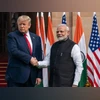
PM Modi US visit: The Donald Trump administration has placed high importance on relations with India, recognising its potential to reshape the Indo-Pacific landscape. | PTI Photo
Listen to This Article
Prime Minister Narendra Modi is in the United States at the invitation of President Donald Trump. During this crucial visit, the two leaders are expected to discuss a broad range of issues — including trade, immigration, defence cooperation, and energy security.
With this visit, PM Modi will be among the earliest world leaders to engage with Trump following his second-term inauguration. His trip follows those of Israeli Prime Minister Benjamin Netanyahu, Japan’s Shigeru Ishiba, and Jordan's King Abdullah II.
Indo-US security cooperation: The 'Quad' factor
Defence and security ties between India and the US are set to be a key focus of PM Modi’s meeting with Trump. As the second Quad leader (after Japan) to visit since Trump’s return to office, PM Modi’s visit underscores the alliance’s growing significance.
Also Read

 "Donald Trump, Trump")
 "Tulsi Gabbard, PM Modi")
 "PM Narendra Modi, PM Modi")
 "Modi, Narendra Modi")
 "Modi, Narendra Modi")
Under successive US administrations, the Quad — comprising India, the US, Japan, and Australia — has evolved into a crucial platform for regional security. Initially dismissed by China as a “headline-grabbing idea” in 2018, the grouping has gained traction in response to Beijing’s increasing assertiveness in the Indo-Pacific.
India will be closely assessing the direction of Quad under Trump’s leadership, particularly as his administration takes a firmer stance on China’s regional influence and global trade policies.
US-India relations: Strategic alignments
As Quad leaders continue their engagements with Washington, the dynamics of the Trump-Modi dialogue will attract global attention. While the institutional framework of Quad expanded significantly during Joe Biden’s presidency, Trump played a pivotal role in its revival.
The new US administration has reaffirmed its commitment to the alliance, with Secretary of State Marco Rubio prioritising a Quad foreign ministers’ meeting as his first official engagement. This move highlights Washington’s sustained focus on the Indo-Pacific.
Harsh V Pant, vice president at the Observer Research Foundation, told MoneyControl that while Trump’s Indo-Pacific strategy revolves around Quad, his approach could place a stronger emphasis on security compared to Biden’s broader diplomatic agenda. PM Modi has consistently framed Quad as a force for regional stability rather than an explicitly anti-China bloc. However, Trump’s sharper strategic focus may test this balance.
US perspective on Quad’s role
For Washington, maintaining security in the Indo-Pacific is not just a regional priority but a strategic necessity. China’s growing military and economic influence — whether through contested maritime claims, control over key shipping routes, or an expanding military presence — has prompted the US to reinforce alliances in the region.
India views Quad as both a means to strengthen its partnership with the US and a strategic counterbalance to China. This dual role aligns with India’s broader diplomatic and security objectives.
Later this year, India is expected to host a Quad summit, which could serve as an opportunity for PM Modi to invite Trump to Delhi. As India and the US deepen their strategic collaboration, their actions will send a strong signal to Beijing, even as economic tensions, particularly trade disputes, remain a factor in the relationship.
Trump administration’s view on India
The Trump administration has placed high importance on relations with India, recognising its potential to reshape the Indo-Pacific landscape. According to Lisa Curtis, a former White House official and now a senior fellow at the Centre for a New American Security, Trump’s team sees India as an essential partner in countering China’s influence.
Curtis, according to a PTI report, highlighted that while trade frictions could be a challenge in this phase of US-India relations, shared interests — such as diversifying supply chains, enhancing maritime security, and strengthening defence ties — will serve as the foundation of their cooperation.
Earlier on January 21, a day after Trump’s inauguration, External Affairs Minister S Jaishankar met Secretary of State Marco Rubio for bilateral discussions and a Quad ministerial meeting. The gathering, which included Australian Foreign Minister Penny Wong and Japan’s Iwaya Takeshi, underscored the renewed focus on the alliance.
While direct references to China may not appear in official statements, Curtis noted that competition with Beijing will be a central theme of PM Modi’s discussions with Trump. The US-India defence relationship has been particularly crucial in countering China’s moves along the disputed border, as seen during the 2020 border standoff when Washington provided intelligence, military equipment, and diplomatic backing to India.
More From This Section
 "US-India, US-India flag, US India flag")
 "India-France, India France flag, India, France")
 "Modi, Narendra Modi, Emmanuel Macron, Emmanuel")
 "Security forces,army,soilder")
 "Defence Minister Rajnath Singh")
Topics : Narendra Modi Donald Trump Quad China Indo-Pacific region US India relations Defence quad security Indian foreign policy maritime security S Jaishankar
Don't miss the most important news and views of the day. Get them on our Telegram channel
First Published: Feb 13 2025 | 9:27 AM IST