


From Bangkok to Mumbai: Where paying rent means losing two-thirds of pay
Residents in Bangkok spend 79 per cent of their income on rent, followed by Mumbai at 66 per cent and Mexico City where renters use over two-thirds of their earnings to pay for housing
 "Banks, property, housing, real estate, market, buildings, cityscape, skyline")
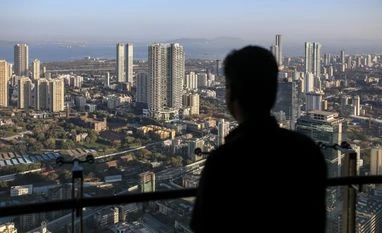
Mumbai sees renters shelling out 66 per cent of their paychecks on housing rent. (Photo/Bloomberg)
Listen to This Article
While cities like New York, London, Zurich, and Singapore are often labeled the world's most expensive, the story changes when we focus solely on rental costs. Surprisingly, some Indian and Asian cities rank higher in rent unaffordability than these global hubs.
A recent report by German asset manager DWS reveals that New York, London, or Singapore are not the most expensive for renters. Instead, Bangkok, Mumbai, and Mexico City lead the pack.
DWS analysed 80 cities worldwide, using median income and average rent to calculate the share of income spent on rent. On average, households spent 38 per cent of their income on rent this year, well above the commonly accepted 30 per cent threshold.
Bangkok topped the chart, with residents spending nearly 79 per cent of their income on rent. Mumbai followed, with renters shelling out 66 per cent of their paychecks. Mexico City was third, with over two-thirds of income going to rent.
Other global hubs such as Hong Kong (61 per cent), New York (53 per cent), and London (52 per cent) also ranked among the 10 least affordable, but higher median incomes in these cities eased the pressure.
Also Read

 "real estate, realty firms")
 "Rohit Sharma and Virat Kohli")

 "Suicide")
 "Sajad Lone")
Indian cities are becoming less affordable
Mumbai’s high ranking is not entirely unexpected. The city has often been linked to steep real estate prices and rents. But other Indian cities are also feeling the pinch. Four Indian cities, including Mumbai, are among the 29 worldwide where residents spend more than 40 per cent of their income on rent.
Bengaluru, often called India’s Silicon Valley, ranks 19th globally, followed closely by Chennai at 20th. Even Kolkata, traditionally considered low-cost, is more expensive than cities like San Francisco, Boston, Munich, and Stockholm.
Among Indian cities, Delhi is an exception. It ranks 20th in global affordability and is the only Indian city with a “high affordability” rating.
Income differences explain the gap
Why do Indian cities seem less affordable than places like San Francisco or London? The answer lies in income. The DWS analysis measures rent as a share of median income, not absolute rent. While absolute rent in San Francisco may be higher, higher median incomes mean residents spend a smaller percentage of their earnings on housing.
For example, a household earning $10,000 and paying $4,000 on rent spends 40 per cent of their income, whereas someone earning $100,000 and paying $25,000 spends only 25 per cent.
Disposable income remains low
Post-rent disposable income highlights the challenge further. Chennai, Mumbai, and Kolkata rank fourth, fifth, and sixth lowest worldwide in remaining financial capacity, with Bengaluru at ninth. In contrast, Singapore and San Francisco, despite high rents, allow households more spending power due to much higher median incomes.
In the US, several cities remain relatively affordable, including Salt Lake City (20 per cent), Austin (23 per cent), Dallas (24 per cent), and Atlanta (25 per cent). Australian cities like Brisbane and Melbourne, as well as European cities such as Leipzig, Lyon, Lille, Stuttgart, Budapest, and Zurich, also perform well.
More From This Section
 "Nominee")
 "Fixed Deposits")
 "loan")
 "SBG, sovereign gold bonds")
 "home loan transfer")
Topics : Housing rent Mumbai Bangkok Chennai BS Web Reports
Don't miss the most important news and views of the day. Get them on our Telegram channel
First Published: Oct 25 2025 | 3:57 PM IST