


H-1B visa registration for 2026 opens on March 7: What Indians must know
Prospective petitioners and representatives must register each beneficiary electronically through a USCIS online account
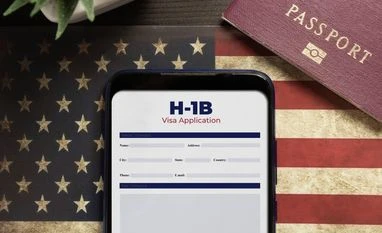 "H1B visa")
Photo: Shutterstock
Listen to This Article
The initial registration period for H-1B visas for the 2026 financial year will open on March 7 and close on March 24, the US Citizenship and Immigration Services (USCIS) announced on Thursday. The H-1B visa is widely used by Indian IT professionals and allows US companies to hire foreign workers for specialised roles requiring technical or theoretical expertise.
Registration starts: March 7, 2025, 10:30 pm IST
Registration closes: March 24, 2025, 10:30 pm IST
Registration fee: $215
Prospective petitioners and representatives must register each beneficiary electronically through a USCIS online account and pay the associated fee during this period.
Also Read

 "Neet exam")
 "India is one of the biggest beneficiaries of H1B visas")
 "Donald Trump, Trump")
 "US President Donald Trump")
 "H-1B Visa")
Changes in the selection process
The FY 2026 H-1B cap will follow the beneficiary-centric selection process introduced in 2025. The US financial year begins on October 1. Under this system, registrations will be selected based on unique beneficiaries rather than individual registrations, reducing the risk of fraud.
“If enough unique beneficiaries are received by March 24, we will randomly select from them and send selection notifications through users' USCIS online accounts,” said USCIS.
If fewer unique beneficiaries register than required, all properly submitted applications will be selected.
Here’s how the initial registration works:
1. Registration window
Employers (or their legal representatives) must create an online account with USCIS and submit registrations for each prospective H-1B worker.
A $10 registration fee is charged for each submission.
2. Lottery selection (if needed)
< If the number of registrations exceeds the annual H-1B cap (which is often the case), USCIS conducts a random lottery.
< There are two separate selections:
Regular cap: 65,000 visas available.
Advanced degree exemption (master’s cap): An additional 20,000 visas for applicants with a US master’s degree or higher.
< USCIS completes the lottery by the end of March and notifies selected applicants.
3. Full petition submission
< Employers whose candidates are selected in the lottery can submit full H-1B petitions with supporting documents.
< Petitions must be filed within 90 days of selection.
< Required documents include:
Form I-129 (H-1B petition)
Labour Condition Application (LCA) from the Department of Labor
Proof of the candidate’s qualifications (degree certificates, work experience, etc)
Job offer details and employer information
4. Approval and start date
USCIS reviews petitions and may request additional evidence (RFE) before making a decision.
If approved, the H-1B visa holder can begin work from October 1 of the same year (the start of the US financial year).
This process applies mainly to private-sector employers filing for first-time H-1B visas. Certain employers, like universities and research institutions, are exempt from the cap and can apply at any time.
Who benefits the most?
Indians receive the largest share of H-1B visas each year. According to data from USCIS, between October 2022 and September 2023, Indians received 72.3% of all H-1B visas.
In the financial year ending September 30, 2023, Indian nationals accounted for approximately 78% of the 265,777 H-1B visas issued by the United States.
The US Congress has set an annual cap of 65,000 visas, with an additional 20,000 for applicants who have completed higher education in the US.
H-1B registration data for FY 2025
Total registrations: 479,953
Eligible registrations: 470,342
Unique beneficiaries: 442,000
Selected registrations: 120,603
Attempts to make H-1B process
In January 2025, USCIS introduced reforms aimed at making the H-1B selection process fairer.
Each individual can now be registered only once, no matter how many employers submit applications on their behalf. Previously, multiple applications increased selection chances.
Passport details must be provided during registration to prevent duplicate and fraudulent submissions.
Providing false information can lead to disqualification and legal consequences.
“The new process ensures a fairer and more transparent selection, reducing the ability to manipulate the system,” said USCIS.
More From This Section
 "income tax")
 "DLF announced that it has sold nearly 41 per cent of its offerings in its super-luxury Dahlias")
 "Valentine")
 "New Zealand")
 "loans, emi, joint-loan, borrowers, home loans, housing, residential, property, repayment, debt, restructuring, moratorium, shares, brokers, agents, stocks, insurance, agreements, contracts")
Topics : H1B Visa
Don't miss the most important news and views of the day. Get them on our Telegram channel
First Published: Feb 10 2025 | 1:06 PM IST