


FSSAI directs states to curb synthetic colouring, carbide use on fruits
FSSAI has asked states to inspect fruit mandis and storage units for illegal ripening agents like calcium carbide and unsafe colouring; violators to face legal action under FSS Act
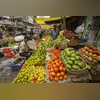 "Fruit, Fruits, vendors, vendor")
Guwahati: Fruits being sold at a wholesale market on the day of the presentation of Union Budget, in Guwahati, Tuesday, July 23, 2024. (Photo: PTI)
Listen to This Article
The Food Safety and Standards Authority of India (FSSAI) has directed all States and Union Territories to intensify inspections and launch targeted enforcement campaigns against the unlawful use of unauthorised ripening agents and synthetic coatings or colouring on fruits.
In an official directive, FSSAI instructed Commissioners of Food Safety across states and UTs, along with its regional directors, to increase surveillance in fruit markets and wholesale distribution centres (mandis) to prevent the use of hazardous substances such as calcium carbide—commonly referred to as ‘masala’—for artificially ripening fruits.
“As part of the enforcement drive, inspection of godowns and storage facilities, particularly those suspected of using substances like calcium carbide for ripening, may be carried out,” FSSAI said in a press release.
The presence of calcium carbide at a site or stored near fruit consignments will be treated as circumstantial evidence and may result in legal proceedings against the concerned Food Business Operators (FBOs) under the Food Safety and Standards (FSS) Act, 2006.
Also Read

 "brain, dementia, Alzheimer's, memory issues")
 "Covid 19, Covid-19, covid")
 "Former US Presidents George Washington, Ulysses S Grant, Grover Cleveland, Herbert Hoover, Lyndon B Johnson, Jimmy Carter, Ronald Reagan, Joe Biden")
 "WHO, World Health Organization")
 "Frustration, office, employee, mental health, stress")
The use of calcium carbide is strictly prohibited under the Food Safety and Standards (Prohibition and Restrictions on Sales) Regulations, 2011. The chemical poses serious health risks, including mouth ulcers, digestive disorders, and potential carcinogenic effects.
Additionally, FSSAI flagged instances where some FBOs were immersing bananas and other fruits directly in ethephon solution for artificial ripening—an unsafe and non-compliant method. In response, the Authority had earlier released a comprehensive guidance note titled Artificial Ripening of Fruits – Ethylene Gas: A Safe Fruit Ripener. The document outlines approved methods for using ethylene gas generated from ethephon, including Standard Operating Procedures (SOPs) for storage, application, ripening chamber specifications, safety protocols, and handling.
FSSAI has strongly advised all stakeholders to adhere strictly to these SOPs to ensure safe and lawful fruit ripening practices. Any violation will attract stringent penalties under the FSS Act.
The Authority also urged all FBOs, supply chain stakeholders, and consumers to remain vigilant and ensure that only safe, properly ripened fruits reach the public, thereby upholding the highest standards of food safety and public health.
More From This Section
 "covid")
 "WHO, World Health Organisation, Bird flu")
 "Kusha Kapila")

 "Weight loss drugs, Wegovy, Ozempic, Zepbound, and Mounjaro")
Topics : Health with BS FSSAI Food safety
Don't miss the most important news and views of the day. Get them on our Telegram channel
First Published: May 20 2025 | 5:19 PM IST