


Trump's H-1B fee: Canada's big chance to lure global tech talent?
Canada could gain as Trump's $100,000 H-1B visa fee pushes tech firms to hire more in Toronto and Vancouver
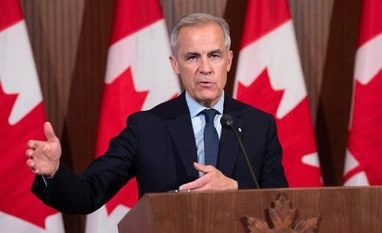 "Mark Carney, Canada PM")
Trump’s $100k H-1B visa may benefit Canada's tech sector’s(Photo: PTI)
Listen to This Article
For years, Canada’s technology and health care sectors have lost talent to the United States. Some industry leaders now see an opening, following President Donald Trump’s decision to impose a $100,000 fee on new H-1B visa applications.
The executive order, signed on Friday, has unsettled companies that depend on the visas to hire programmers, engineers and other skilled workers from abroad.
Tech leaders call US Visa Fee Hike a gift for Canada
“This is a massive gift to every overseas tech hub,” said Garry Tan, chief executive of Y Combinator, in a post on X that was later deleted. He described the policy as a “toll booth” that would make it harder for smaller US firms to bring in talent, while cities like Vancouver and Toronto could benefit instead.
Major American employers already have a strong presence north of the border. Amazon employed more than 8,500 staff in Vancouver and Toronto tech hubs as of last year. Microsoft had 2,700 in its Vancouver development hub as of April, while Alphabet also operates offices across Canadian cities.
Carney signals Canada’s chance
Prime Minister Mark Carney, speaking in New York on Monday, noted that Canada produces large numbers of graduates in fields such as artificial intelligence and quantum computing.
Also Read

 "Canada, Ottawa, Ontario")
 "Anita Anand")
 "Sikh separatist leader Gurpatwant Singh Pannun")
 "Tiktok")
 "Khalistani")
“Most of them go to the United States,” he said. “I understand you’re changing your visa policy here, so we’re going to hang on to a few of those.”
ALSO READ: End work permits for foreign students: Republicans after H-1B visa revamp
What Canada could gain from US visa fee
< Increased hiring by American firms in Canadian offices to avoid US costs
< Potential return of Canadian-educated AI and quantum graduates who previously left for the US
< Renewed demand for special Canadian work permits targeting H-1B holders
Pay gap and old playbooks
The pull of the US has long been reinforced by salaries. The median tech worker earns 46 per cent more in the US than in Canada, according to a 2023 report by The Dais, a think tank at Toronto Metropolitan University.
“That’s been Silicon Valley’s playbook for many years, and all the top talent have been moving to the US,” said Dan Burgar, co-founder of Frontier Collective, a nonprofit supporting emerging startups in Vancouver. The new fee, he said, means “they’re closing the door on the very talent that built Silicon Valley.”
Earlier experiments show appetite
Canada has already tested ways to draw workers frustrated with the US visa system. In 2023, it offered three-year work permits to H-1B holders. The cap of 10,000 applications was filled within 48 hours, according to entrepreneur Martin Basiri, who worked with the government on the programme.
Basiri now wants a similar scheme revived, but linked to companies creating new jobs in Canada. He argued that such a move would balance the need for skilled labour with concerns about unemployment, currently above 7 per cent, and pressures on housing and infrastructure.
Pressure on skills supply
Domestic supply alone cannot meet Canada’s needs, according to sector leaders. In a recent MSM Unify Live Expert Session on Canada student pathways, Virginia Machiavello, CEO and president of Machiavello Consulting Limited, said: “Our reproduction in Canada is 1.3. We do not have enough domestic students to fill our workforce. And the challenge that’s coming up with commercialising and building out manufacturing and commercialising our resources, we’re going to need a skilled workforce. We do not have those numbers.”
More From This Section
 "H1B visa")
 "US visa, H4, H1B")
 "green card, h1b visa")
 "US visa, US students")
 "Germany")
Don't miss the most important news and views of the day. Get them on our Telegram channel
First Published: Sep 24 2025 | 3:03 PM IST