


Trump's H-1B visa curbs may lure tech talent to China, warns US lawmaker
China's new K visa could attract global tech talent as Trump's $100,000 H-1B fee and tighter student visa rules risk pushing innovators away from the US
 "Donald Trump, Trump")
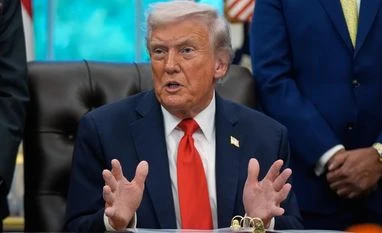
Trump's H-1B visa Fee Hike may lure tech talent to China (Photo:PTI)
Listen to This Article
The top Democrat on the House China Committee has warned that a new Chinese visa programme could attract global technology talent away from the United States, just as Washington raises fresh barriers for skilled workers and students.
Representative Raja Krishnamoorthi wrote to Secretary of State Marco Rubio, Homeland Security Secretary Kristi Noem and Labour Secretary Lori Chavez-DeRemer, cautioning that the Trump administration’s immigration changes could weaken America’s economic position.
“The administration’s decision to raise fees and restrict student visas risks driving talent elsewhere,” Krishnamoorthi said in his letter, seen by Business Standard. “Beijing is throwing its doors wide open to draw people who might otherwise contribute to the US technology sector.”
The letter was sent on Tuesday evening.
What is China’s new K visa?
Also Read

 "H1B visa")
 "Donald Trump, Trump")
 "market rally, sensex, nifty")
 "green card, h1b visa")
China rolled out its K visa programme earlier this month, after announcing it in August. The new category allows young science and technology graduates to move to China without a job offer or local sponsor.
The K visa is seen as an effort to compete for global talent disillusioned by high US visa costs and restrictions. Holders can reportedly switch jobs more easily and stay in the country between employment contracts.
“While America disincentivises the H-1B and closes its advanced degree pathways to foreign students, the PRC is positioning the K visa as a powerful magnet for global talent,” wrote Krishnamoorthi, the ranking member on the House Select Committee on China.
Trump’s $100,000 H-1B fee sparks backlash
Krishnamoorthi’s warning follows the Trump administration’s plan to impose a $100,000 fee on new H-1B skilled worker applications and a four-year cap on student visas. Business leaders and industry groups have voiced alarm over the measures.
“American business leaders are warning that proposed changes to H-1B visas would harm both American companies and US economic competitiveness,” Krishnamoorthi wrote.
The US Chamber of Commerce recently sued the Trump administration, calling the policy “plainly unlawful.” In a statement, Neil Bradley, executive vice president of the Chamber, said, “The new $100,000 visa fee will make it cost-prohibitive for US employers, especially start-ups and small and midsize businesses, to utilise the H-1B programme.”
Sectors most at risk from the policy shift
The letter warned that research-heavy sectors such as semiconductors and healthcare could lose talent to China.
“In rural areas, physician shortages will worsen due to proposed changes to J visas for exchange visitors,” the letter noted. “H-1B fee burdens could also stifle the start-up ecosystem.”
Krishnamoorthi cited a 2024 study showing that every additional H-1B worker hired increases total firm employment by 0.83 additional employees. “Limiting this flow of talent would jeopardise one of America’s greatest strengths—its start-up culture,” he wrote.
Business and academic voices join concern
Executives in the semiconductor and higher education sectors have echoed these warnings.
“More than two dozen semiconductor executives have said that the Trump administration’s plans for strict time limits on F visas will block vital talent from reaching the United States,” Krishnamoorthi wrote. “One executive warned that restricting international graduates ‘jeopardises innovation capacity and the US’s ability to lead in a sector critical to national security.’”
Medical leaders have expressed similar alarm. “According to Dr Jason M Goldman, president of the American College of Physicians, the Trump administration’s proposal would affect more than 17,000 physicians and disrupt patient care nationwide,” Krishnamoorthi noted. “These doctors are disproportionately represented in underserved and rural communities.”
“A strategic coup” for China
Krishnamoorthi contrasted the restrictions in Washington with Beijing’s more welcoming policy.
“In response to the Trump administration’s illogical and potentially illegal changes, Beijing is throwing its doors wide open with its newly introduced K visa—designed to lure young STEM graduates,” he wrote. “As our immigration policies push away future founders, doctors, scientists, and researchers, the PRC is branding itself as the place where the next generation of businesses and breakthroughs will take root.”
He warned that by undervaluing immigrants, the United States risks “handing General Secretary Xi Jinping a strategic coup.” The K visa, he said, does not merely attract talent but redirects “the wealth, patents, and job creation that once sustained America’s economic leadership straight into the PRC’s economy.”
Questions raised for the US government
Krishnamoorthi urged the Departments of Labour, Homeland Security and State to explain whether they had assessed the economic cost of the proposed restrictions, studied China’s K visa strategy, or developed safeguards to prevent US-trained graduates from being recruited to the PRC.
He is not the only lawmaker raising concerns. The US Chamber of Commerce and a coalition of business groups representing chipmakers, software firms and retailers have also pressed President Donald Trump to reconsider the H-1B changes.
Krishnamoorthi’s letter concludes that Beijing’s move is “a likely deliberate attempt to attract talented immigrants who might otherwise create wealth in the United States.”
More From This Section
 "US visa, H4, H1B")
 "Canada, Ottawa, Ontario")
 "New Zealand")
 "Mark Carney, Canada")
 "IGI Airport")
Don't miss the most important news and views of the day. Get them on our Telegram channel
First Published: Oct 24 2025 | 4:07 PM IST