


AI171 black box not being sent to US for forensic probe, clarifies Centre
Crucial flight data recovery from the charred recorders of AI-171 may unlock the truth behind the deadly crash
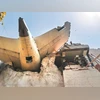 "Air India, plane crash")
The ill-fated Air India flight, bound for Gatwick Airport in the UK, took off around noon on June 12, 2025.
Listen to This Article
India isn't sending the black box of the Air India Flight AI-171 to the United States for advanced forensic analysis. This clarification was issued by the civil aviation ministry on Thursday after media outlets reported that the black box is being sent to the US.
In a statement, the Ministry of Civil Aviation said, "It has been reported in certain media outlets that the CVR/DFDR from the ill-fated AI171 flight is being sent abroad for retrieval and analysis. The decision regarding the location for decoding the flight recorders will be taken by the AAIB after due assessment of all technical, safety, and security considerations. The Ministry of Civil Aviation urge all stakeholders to refrain from speculation on such sensitive matters and to allow the investigative process to proceed with the seriousness and professionalism it warrants."
The black box—comprising the Digital Flight Data Recorder (DFDR) and the Cockpit Voice Recorder (CVR)—was recovered from the wreckage after the Boeing 787 Dreamliner tragically crashed just minutes after takeoff from Ahmedabad’s Sardar Vallabhbhai Patel International Airport. The crash claimed 275 lives, including 242 passengers, 33 people on the ground, and left only one survivor.
Why the black box matters
The black box is one of the most critical components in modern aircraft crash investigations. It contains vital data and audio recordings that can help piece together the events that led to a disaster. In the case of AI-171, the crash occurred within moments of departure, with little time for external observers to assess what went wrong. The pilot managed to send a single Mayday call but failed to respond afterward, leaving a significant information gap that only the black box can fill.
According to international aviation protocols, the Aircraft Accident Investigation Bureau (AAIB) of India is responsible for probing the incident since the crash occurred on Indian soil.
Also Read

 "Air India")
 "N Chandrasekaran")
 "Air India")
 "Air India plane crash")
 "Praful Patel")
What's inside a black box?
Despite its name, the black box is neither black nor a single device. It consists of two separate but equally important recorders:
- Flight Data Recorder (FDR): Logs thousands of parameters from the aircraft’s systems, such as speed, altitude, heading, engine performance, and control positions.
- Cockpit Voice Recorder (CVR): Records audio from the cockpit, including pilot conversations, alarms, and ambient sounds that may indicate issues.
The outer casing of a black box is made of heat-resistant stainless steel or titanium and is painted bright orange or yellow for visibility during recovery. It is built to withstand extreme conditions: high-impact crashes, fire, saltwater submersion, and pressures equivalent to thousands of G-forces.
These boxes also feature an Underwater Locator Beacon (ULB), which activates upon contact with water and emits a signal to help search teams find them in ocean crashes. ALSO READ | Air India crash: 208 victims identified by DNA, 170 bodies handed over
What happened to AI-171?
The ill-fated Air India flight, bound for Gatwick Airport in the UK, took off around noon on June 12, 2025. Just seconds after takeoff, the aircraft crashed at a low altitude of only 625 feet, striking the rooftop of a medical college building. Emergency responders quickly recovered the black box from the debris, though the equipment showed signs of fire and impact-related damage.
Civil Aviation Ministry Secretary Samir Kumar Sinha confirmed that the last radio contact from the pilot was a distress Mayday call, after which there was radio silence. “He didn’t respond back to the air traffic control,” Sinha said.
Investigators are now examining several possibilities:
- Whether the aircraft’s wing flaps were fully extended
- Why the landing gear was deployed
- Whether there was a fuel contamination issue
- If an electronic system failure caused engine shutdown
The Boeing 787 Dreamliner is built with extensive redundancy in its systems, designed to continue flying safely even after multiple component failures. It can fly up to 345 minutes on a single engine. This makes the sudden crash of a new-generation aircraft especially perplexing to experts.
More From This Section
 "Thug Life box office collection day 7")
 "smartphone")
 "IT industry, IT companies, IT sector, Jobs, IT jobs")
 "Supreme Court, SC")
 "Traffic, Traffic jam, Gurugram Traffic")
Topics : Air India ahmedabad plane crash air crash crash boeing dreamliners Ahmedabad BS Web Reports
Don't miss the most important news and views of the day. Get them on our Telegram channel
First Published: Jun 19 2025 | 3:07 PM IST