


Air India pilot gave 'Mayday' call to ATC: What it means, what follows
According to the DGCA, minutes after the takeoff, the pilot gave a 'Mayday' call to Air Traffic Control (ATC), after which they lost communication and crashed
 "Ahmedabad Plane Crash, Plane Crash")
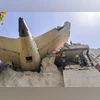
Remains of an Air India plane that crashed moments after taking off from the Ahmedabad airport, Thursday, June 12, 2025.(Photo: PTI)
Listen to This Article
A London-bound Air India flight, carrying 242 people, crashed into a residential area in Meghaninagar near Ahmedabad airport, on Thursday.
According to the Directorate General of Civil Aviation (DGCA), minutes after the takeoff, the pilot gave a 'Mayday' call to Air Traffic Control (ATC), after which they lost communication and crashed.
"As per ATC, the aircraft departed from Ahmedabad at 1.39 pm from runway 23. It gave a Mayday call to ATC, but thereafter no response was given by the aircraft to the calls made by ATC. Aircraft immediately after departure from runway 23, fell on ground outside the airport perimeter. Heavy black smoke was coming from the accident site," the DGCA said.
"The aircraft was under the command of Capt Sumeet Sabharwal with First Officer Clive Kundar. Capt Sumeet Sabharwal is an LTC with 8200 hours of experience. The co-pilot had 1100 hours of flying experience," DGCA added.
Also Read

 "Ahmedabad Plane Crash, Plane Crash")
 "Ahmedabad Plane Crash, Plane Crash")
 "Air India, plane crash")
 "Vijay Rupani")
 "Xi Jinping, Jinping, China President")
What is a Mayday Call?
A Mayday call is an internationally recognised radio distress signal used by pilots and mariners to indicate a life-threatening emergency. Accoridng to Merriam-Webster, he term originates from the French phrase m’aider, meaning “help me.” Pilots issue a Mayday in situations involving grave and imminent danger such as engine failure, fire on board, or loss of control.
To make a Mayday call, the pilot repeats the word “Mayday” three times, followed by essential details including the nature of the emergency, the aircraft’s call sign, position, altitude, and any intended actions. This alert notifies all nearby ATC units and aircraft of the emergency.
What happens after a Mayday call?
Upon receiving a Mayday call, ATC immediately prioritises the distressed aircraft above all other traffic. Communications on the frequency may be suspended or redirected to ensure a clear channel. Controllers attempt to maintain contact with the aircraft, providing directions for an emergency landing if possible, clearing surrounding airspace, and coordinating ground emergency services.
In the case of the Ahmedabad crash, the aircraft ceased communication after the Mayday call, indicating a possible rapid escalation of the emergency on board. When contact is lost, controllers rely on the aircraft’s last known position and radar data to monitor its trajectory.
Emergency services, including fire, medical, and rescue teams, are dispatched promptly to the site.
Role of the DGCA following a Mayday call
After a Mayday call, the DGCA oversees the initial response and ensures that the necessary investigations are launched in compliance with aviation safety regulations. The DGCA collaborates closely with the Aircraft Accident Investigation Bureau (AAIB), which conducts a technical inquiry to determine the cause of the incident.
As part of the investigation process, authorities retrieve the flight data and cockpit voice recorders — commonly referred to as black boxes — interview available crew members and witnesses, and examine the wreckage. Investigators collect relevant information on the aircraft’s configuration, crew qualifications, weather conditions at the time, and the sequence of events that occurred before the crash.
If the aircraft is registered in another country or includes components designed or manufactured abroad, the DGCA and AAIB inform the respective states and the International Civil Aviation Organisation (ICAO), in accordance with international guidelines. An initial report is generally prepared in the early phase, followed by a final report that presents the findings and includes safety recommendations to help reduce the risk of similar incidents.
More From This Section
 "Ahmedabad Plane Crash, Plane Crash")
 "Ahmedabad Plane Crash, Plane Crash")
 "Nirmala Sitharaman, Nirmala")
 "accident")
 "police")
Don't miss the most important news and views of the day. Get them on our Telegram channel
First Published: Jun 12 2025 | 7:51 PM IST