


VP Dhankhar criticises SC deadline, questions FIR delay against judge
Vice-President objects to SC deadline for Presidential action under Article 201 and questions judicial delay in judge cash haul case
 "Jagdeep Dhankhar, Jagdeep, Dhankhar, VP")
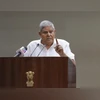
Vice President Jagdeep Dhankhar slammed the Supreme Court's directive setting a timeline for the President to decide on bills (Photo: PTI)


Listen to This Article
Vice-President Jagdeep Dhankhar has strongly objected to the Supreme Court setting a three-month deadline for the President to decide on state bills under Article 201. Addressing the sixth batch of Rajya Sabha interns, Dhankhar said, “There cannot be a situation where courts direct the President.”
VP raises concerns over cash haul at Delhi judge’s residence
He also raised serious concerns over the handling of the alleged cash haul from the residence of Delhi High Court judge Yashwant Varma. The incident, which took place on the night of March 14–15, became public only a week later and has sparked nationwide debate over transparency and accountability within the judiciary.
Delay raises fundamental questions, says Dhankhar
“Let me take incidents that are most recent. They are dominating our minds,” Dhankhar said, referring to the reported raid. “For seven days, no one knew about it. We have to ask ourselves: Is the delay explainable? Condonable? Does it not raise certain fundamental questions?”
He pointed out that the public only became aware of the incident on March 21, after it was reported in the media. “In any ordinary situation — and ordinary situations define rule of law — things would have been different. It was only when it was disclosed by a newspaper that people of the country were shocked as never before,” he said.
Dhankhar noted that the Supreme Court eventually acknowledged the matter. “Fortunately, in the public domain, we had input from an authoritative source: the Supreme Court of India. And the input indicated culpability. Input did not lead to doubt that something was amiss. Something required to be investigated.”
Also Read

 "JK Rowling")
 "Supreme Court, SC")
 "Quran")
 "Supreme Court, SC")
‘Even if it’s a can of worms, let the truth come out’
Reflecting the public’s impatience, he added, “Now the nation waits with bated breath. The nation is restive because one of our institutions, to which people have looked up always with the highest respect and deference, was put in the dock. It is now over a month. Even if it is a can of worms. Even if there are skeletons in the cupboard, time to blow up the can. Time for its lid to go out. And time for the cupboard to collapse. Let the worms and skeletons be in the public domain so that cleansing takes place.”
The Vice-President pointed out that no FIR had yet been filed against the judge despite the seriousness of the allegations. “Because for a criminal investigation, the initiation has to be by an FIR — First Information Report. It is not there. It is the law of the land that every cognisable offence is required to be reported to the police. And failure to do so — failure to report a cognisable offence — is a crime,” he said.
Dhankhar questions unwritten immunity for judges
He explained that while any other citizen could be named in an FIR without special permission, judges appeared to enjoy an unwritten protection that is not provided for in the Constitution. “An FIR in this country can be registered against anyone — any constitutional functionary. One has only to activate the rule of law. No permission is required. But if it is judges — FIR cannot be straightaway registered. It has to be approved by the concerned judiciary. But that is not given in the Constitution. The Constitution of India has accorded immunity from prosecution only to the Hon’ble President and the Hon’ble Governors,” he said.
Questioning the perceived immunity, Dhankhar added, “So how come a category beyond law has secured this immunity? Because the ill-effects of this are being felt in the mind of one and all. Every Indian, young and old, is deeply concerned. If the event had taken place at his house, the speed would have been an electronic rocket. Now, it is not even a cattle cart.”
(With agency inputs)
More From This Section
 "Murshidabad Security, Murshidabad, Murshidabad violence")
 "Uber")
 "‘Moving Constant' by N Ramachandran and V Anamika at art museum at Mumbai Airport's Terminal 2 | photo:Ranjita Ganesan")
 "Exam")
Don't miss the most important news and views of the day. Get them on our Telegram channel
First Published: Apr 17 2025 | 5:07 PM IST