


SC questions Article 17 use in Sabarimala, Nagarathna flags logic
A nine-judge Supreme Court Bench questions applying Article 17 to Sabarimala entry restrictions, with Justice BV Nagarathna highlighting concerns over its doctrinal relevance
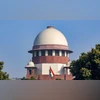 "SC, Supreme Court")
The Bench clarified at the outset that it would not revisit the correctness of the 2018 verdict but would confine itself to the larger constitutional issues referred in 2019. (Photo: PTI)
Listen to This Article
A nine-judge Bench of the Supreme Court of India on Tuesday questioned the invocation of Article 17 of the Constitution of India in the Sabarimala temple entry case, with Justice BV Nagarathna observing that a woman cannot be treated as "untouchable" for three days in a month and then cease to be so on the fourth day.
Article 17 of the Indian Constitution abolishes "untouchability" and forbids its practice in any form, making the enforcement of any disability arising from it a punishable offence.
The remarks came after Solicitor General Tushar Mehta criticised the 2018 ruling, particularly the view that exclusion of women aged 10-50 amounted to a form of untouchability prohibited under Article 17. In that judgment, Justice DY Chandrachud had held that restrictions rooted in notions of menstrual impurity could fall within the ambit of untouchability.
"One opinion in Sabarimala says Article 17 applies to women — you are treating them as untouchables — I have a very strong objection to it. India is not that patriarchal or gender stereotyped in the way that the West understands," Mehta said.
Justice Nagarathna, the only woman on the Bench, questioned the doctrinal fit of Article 17 in this setting, noting its historical grounding in caste-based discrimination.
Also Read

 "Supreme Court, SC")
 "Supreme Court")
"Article 17, in the context of Sabarimala, I don't know how it can be argued. Speaking as a woman, there can't be a three-day untouchability every month, and on the fourth day, there is no untouchability," she said.
When the Solicitor General clarified that his arguments were not centred on menstruation, she reiterated, "Speaking as a woman, Article 17 can't apply for 3 days and on the 4th day, there is no untouchability."
Mehta maintained that the restriction at the Sabarimala temple was based on age classification rather than menstruation, stating, "I will defend Sabarimala in my own different way; it does not mean 4 days, it means a particular age group."
He also emphasised that temples dedicated to Lord Ayyappa elsewhere admit women, while Sabarimala represents a distinct denominational practice. Drawing parallels with other faith-based customs, he argued that visitors to religious spaces such as mazars or gurdwaras accept prescribed norms without framing them as violations of dignity or autonomy.
Mehta also submitted before the Bench that the 2018 verdict requires reconsideration and reversal on legal grounds.
"It is my case that it is wrongly decided and deserves to be declared a wrong law," the Solicitor General stated during the hearing.
The Bench clarified at the outset that it would not revisit the correctness of the 2018 verdict but would confine itself to the larger constitutional issues referred in 2019.
Opening submissions, Mehta referred to Constituent Assembly debates on Articles 25 and 26, contending that the judicially evolved “essential religious practices” test is flawed and that courts should not determine what constitutes an essential practice. He submitted that reform in religious matters is constitutionally entrusted to the legislature under Article 25(2)(b).
The 2018 judgment, delivered by a five-judge Bench by a 4:1 majority, had permitted entry of women of all age groups into the Sabarimala temple, holding that devotion cannot be subjected to gender discrimination. In November 2019, a five-judge Bench, which was hearing the review petitions filed against the Sabarimala verdict, referred certain issues to a nine-judge Bench.
More From This Section
 "Dark clouds, clouds, Black Clouds, monsoon")
 "India Bangladesh")
 "Yumnam Khemchand Singh, Yumnam Khemchand")
 "Yumnam Khemchand Singh, Yumnam Khemchand")
 "toll plaza, fastag, fast tag, tolling fee")
Don't miss the most important news and views of the day. Get them on our Telegram channel
First Published: Apr 07 2026 | 7:53 PM IST