


India's auto component firms go digital amid world crises, EVs: Report
Digitalisation, automation and smart factories no longer a luxury for sector, it says
 "Automakers, car makers, cars, automobile manufacturers, auto industry")
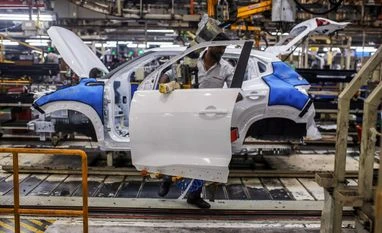
Beyond productivity, digitisation is emerging as a risk-management tool | Image: Bloomberg
Listen to This Article
India’s auto components industry is at an inflexion point that has smart factories shifting from “nice to have” to becoming critical to business as global supply chains realign amid geopolitical uncertainty and trade agreements, said a report on Wednesday.
The sector is worth $80 billion and targets a $200 billion opportunity by 2030, split evenly between domestic demand and exports, according to a joint report by Boston Consulting Group (BCG) and the Automotive Component Manufacturers Association of India (ACMA). Exports account for around 30 per cent of production but the industry has only about 2 per cent of global auto component trade, compared with China’s 12–13 per cent share.
“This is a capital-intensive industry, and investing in sync with demand is something it has always lived by,” said Vikram Janakiraman, managing director and senior partner at BCG. “What has changed is that the envelope of what can be delivered from the same asset base is much higher through smart automation and smart factories.”
Multiple forces are changing the auto components industry. Global vehicle production is expected to rise to 50–55 million units by 2030, increasing product variants and changeovers. Internal combustion engine (ICE) and electric vehicle (EV) programmes are running in parallel, creating a dual investment squeeze for suppliers.
“India’s powertrain roadmap is still evolving. ICE will continue to be the mainstay even as EV volumes scale up,” said Vinnie Mehta, director general, ACMA. “Given our high cost of capital, we have no choice but to sweat existing ICE assets harder to fund EV investments without overextending balance sheets.”
Also Read

 "electric vehicle, ev industry")
 "Shailesh Chandra")
 "Stellantis")
 "Yamaha Motor, EC-06 scooter, Electric scooter")
 "MHCV cycle, medium heavy commercial vehicles, replacement demand trucks, GST reset CV sector, MHCV recovery India, Tata Motors MHCV, Ashok Leyland MHCV, freight rates India")
Industry earnings before interest, taxes, depreciation and amortisation margins average 11–12 per cent and are lower for smaller firms, while volatile commodity prices and currency depreciation continue to weigh on costs. In this backdrop, efficiency gains are becoming non-negotiable.
The report highlighted that global benchmarks show 10–20 per cent productivity gains, 5–10 per cent cost improvement, 20–30 per cent quality improvement and 20–40 per cent faster time-to-market from smart factory adoption. Indian case studies show similar benefits, particularly from uncovering “true baselines” in operations.
“In many plants, Overall Equipment Effectiveness was believed to be around 80 per cent, but once digital data capture was implemented, companies realised it was closer to 60–65 per cent,” the report said. Establishing a “single source of truth” helped several firms drive 15–20 per cent productivity improvements without major capital expenditure.
Digitisation is becoming a hygiene factor for global customers. “India is great at cost but customers want better traceability, more consistent quality and stronger data-backed problem-solving,” Janakiraman said, referring to interactions with original equipment manufacturers (OEMs) and Tier-I suppliers in Europe and the US. “Switching suppliers is not a drop-in replacement in auto. Validation cycles are long, and digital maturity plays a big role in winning that trust.”
“Smart manufacturing directly addresses these gaps by improving traceability, faster development cycles and integration with OEMs. Traceability is also critical for sustainability and recycling regulations, where producer responsibility is increasing,” Gurbani Bagga, partner at BCG, said.
Geopolitics amplified opportunities for the industry. China pursued EVs with focus for over two decades, helping it dominate global supply chains. But the country’s rising costs and geopolitical risk have accelerated the China-plus-one strategy.
“Geopolitics has placed India firmly on the global radar,” Mehta said. “This truly is India’s decade. Missing this moment would be a lost opportunity.”
Crucially, smart manufacturing is no longer prohibitively expensive. “Sensors and computing costs have collapsed,” Janakiraman noted. “Even 15-year-old machines can generate usable data. These investments are incremental, return-on-investment positive and accessible even to micro, small and medium enterprises.”
The report also points to frugal Indian innovations, including low-cost sensors and creative data capture, that are making digital adoption affordable. Young plants using digital standard work and traceability are now matching the performance of mature sites far faster than before.
Beyond productivity, digitisation is emerging as a risk-management tool. “For exporters, a single quality failure or recall can be devastating,” Mehta said. “Digitisation significantly mitigates that risk while improving pricing power and competitiveness.”
With FTAs opening doors, vehicle makers expanding capacity at home, and global customers demanding speed and resilience, the message from the report is clear: For Indian auto component suppliers, smart factories are no longer optional — they are the price of relevance in a rapidly changing world.
More From This Section
 "Automakers, carmakers, auto industry")
 "Tata Motors")
 "carmakers, auto industry")
 "X440")
 "TVS Jupiter")
Don't miss the most important news and views of the day. Get them on our Telegram channel
First Published: Feb 11 2026 | 11:27 AM IST