


Day after crash, DGCA orders safety checks for Air India's Boeing 787 fleet
DGCA has ordered immediate safety inspections of Air India's Boeing 787 fleet after a fatal crash in Ahmedabad killed 241 people. Checks include fuel systems, engine controls, and flight parameters
 "Air India")
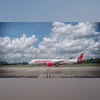
The DGCA has instructed Air India to immediately carry out extra maintenance checks on both variants of its Dreamliner fleet. | File Photo
Listen to This Article
Following the deadly Air India crash in Ahmedabad that claimed at least 265 lives, the Directorate General of Civil Aviation (DGCA) on Friday, 13 June, ordered enhanced safety inspections across the airline’s Boeing 787 Dreamliner fleet.
Air India, owned by the Tata Group, currently operates 33 Boeing 787 aircraft — including 26 of the 787-8 variant and seven 787-9s — all powered by GEnx engines.
The DGCA has instructed Air India to immediately undertake intensified maintenance inspections, to be carried out in coordination with regional DGCA offices.
Details of the mandated checks
The regulator has directed Air India to submit reports for all completed checks for internal review and further assessment.
Also Read

 "Air India, plane crash")
 "Ahmedabad Plane Crash, Plane Crash")
 "Ahmedabad Plane Crash, Plane Crash")
 "N Chandrasekaran")
Ahmedabad crash kills 265
On Thursday afternoon, Air India flight AI 171 — a London-bound Boeing 787 Dreamliner — crashed shortly after take-off from Sardar Vallabhbhai Patel International Airport, Ahmedabad. The aircraft burst into flames after hitting the BJ Medical College and Civil Hospital campus in Meghaninagar.
At least 265 people were killed, including ground casualties. Of the 242 people on board — 230 passengers and 12 crew members — only one survived. Many bodies were found charred beyond recognition, making identification efforts difficult. The crash marks one of the deadliest aviation disasters in India in recent years.
Spotlight returns to Boeing’s safety record
The Ahmedabad crash has intensified scrutiny of Boeing’s safety and manufacturing practices. The American aerospace giant has been under investigation for multiple systemic failures linked to its aircraft.
Previous crises include the high-profile crashes of Lion Air Flight 610 in 2018 and Ethiopian Airlines Flight 302 in 2019. Both involved the Boeing 737 MAX and were attributed to faults in the MCAS (Maneuvering Characteristics Augmentation System), which mistakenly forced the aircraft’s nose down. The two disasters resulted in 346 deaths and led to a near two-year global grounding of the 737 MAX fleet.
In January last year, a mid-air incident involving Alaska Airlines’ 737 MAX 9 — where a door panel blew off due to missing bolts — further damaged the company’s reputation. Though no lives were lost in that incident, it triggered a Federal Aviation Administration (FAA) audit of Boeing’s manufacturing and safety protocols.
With the Ahmedabad crash now under formal investigation, the DGCA's swift action signals a renewed focus on operational vigilance and technical scrutiny — especially for wide-body, long-haul aircraft like the Dreamliner.
More From This Section
 "Air India, plane crash")
 "Boeing CEO, Kelly Ortberg")
 "Air India")
 "Air India")
Don't miss the most important news and views of the day. Get them on our Telegram channel
First Published: Jun 13 2025 | 6:21 PM IST