


India-EU FTA: No concessions for New Delhi over CBAM regulations
CBAM relaxations offered by EU to other partners will apply to India: commerce secretary
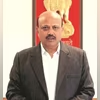 "Rajesh Agarwal, Commerce Secretary")
Rajesh Agarwal, Commerce Secretary
Listen to This Article
India did not receive any concessions on the European Union’s (EU) carbon regulations as part of the free trade agreement (FTA) concluded between the two sides.
India, however, has secured a commitment that any flexibility offered by the EU on the carbon border adjustment mechanism (CBAM) to other trading partners will also apply to Indian exporters. Government officials said the EU’s CBAM regulation — which came into force on January 1 — was among the toughest issues in the negotiations, as Brussels was unwilling to provide any country-specific flexibility or exemption.
The FTA also provides for a rebalancing of rights if EU measures under the regulation impair the benefits of the pact for Indian firms, or if the EU fails to establish adequate grounds for such measures.
CBAM, aimed at preventing “carbon leakage”, seeks to put a fair price on carbon emitted during the production of carbon-intensive goods entering the EU. Under the regulation, imports exceeding 50 tonnes of cement, iron and steel, aluminium, fertiliser, electricity and hydrogen require authorisation at the time of import. The measure is not India-specific and applies to all countries.
A technical group will be set up to help Indian companies get their carbon data verified and better understand EU rules. This could allow India’s future carbon pricing system to be recognised and help avoid double taxation.
Also Read

 "artificial intelligence, AI applications, Indian startups, Silicon Valley, Gnani.ai")
 "6g")
 "India IT industry, IT services, automation, artificial intelligence, AI, generative AI, Gen AI, skill transformation, organisational structure, entry-level engineers, pyramid structure, diamond-shaped workforce, mid-tier workforce, IT hiring trends,")
 "Modi, Narendra Modi, Antonio Costa, Ursula von der Leyen, Ursula, von der Leyen, Leyen")
 "Modi, Narendra Modi, Antonio Costa, Ursula von der Leyen, Ursula, von der Leyen, Leyen")
“Under the FTA, there are certain provisions that we have agreed under CBAM. One, a technical dialogue has been agreed to be set up, which will address the pathway for our industries to access the market, despite the CBAM regulation. We'll be working together to see that the verifiers for CBAM in India are also accredited by the use agency, so that our industry is able to access them,” Commerce Secretary Rajesh Agarwal told reporters on Tuesday.
“We’ll also be working together to see and understand the technical processes through which CBAM measurement will be done in both the economies. This group will also provide that whatever Indian carbon trading system comes into future that will be also accounted for and plugged into their system, to see that the industry which is part of the carbon trading pricing ecosystem India, is accounted for their payments here,” Agrawal added.
A government official said there is a non-violation clause to protect India’s interests against any new measures. “We do have a non-violation clause also in the agreement. If a new measure comes later, which nullifies concessions to us under the FTA, we do have consultation rights, and if the consultation does not yield any result, we do have re-balancing rights,” the official said.
India is also seeking improved and higher access to tariff-free EU steel import quotas as an FTA partner.
India’s request comes against the backdrop of the European Council adopting its mandate to negotiate with the European Parliament on a regulation addressing the negative trade-related effects of global overcapacity on the EU steel market. The new regulation is designed to replace the existing steel safeguard measure, which is due to expire on June 30. The Council’s mandate aims to maintain a high level of protection for the European steel industry.
More From This Section
 "Supreme Court, SC")
 "Tata power")
 "India's Technology Minister Ashwini Vaishnaw")
 "SC, Supreme Court")
 "Lahori Zeera, beverage")
Don't miss the most important news and views of the day. Get them on our Telegram channel
First Published: Jan 27 2026 | 8:02 PM IST