"Freight demand on the network is projected to reach 8,000 billion tonnes by 2030. Indian Railways is now the world's second-largest cargo carrier by volume, up from fourth, even as its share of the country's total freight movement remains well below potential," Rajesh Agarwal, additional member (works), Railway Board, said.
Speaking at an event organised by the Federation of Indian Chambers of Commerce and Industry (FICCI) here, Agarwal said the procedural reforms meant to speed up execution include ensuring that pre-investment work, such as land acquisition and forest clearances, begins before formal project sanction rather than after.
"An artificial intelligence-based drawing approval tool, developed with RailTel, is intended to cut delays in drawing approval sign-off. Procurement is being centralised, with more risk transferred to contractors alongside greater decision-making freedom, and long-term, five-year Project General Management Services contracts will replace shorter supervision arrangements," he said.
Agarwal also said the ministry is developing a Public Information Module (PIM) to house all information regarding projects on the websites of zonal railways. "These modules will be available well before the calling of tenders, and industry partners are expected to explore site conditions in advance and suggest modifications in tender conditions if needed," he said.
Agarwal also called on manufacturers and micro, small and medium enterprises (MSMEs) to develop construction machinery suited to railways' constrained right of way and standardised precast components. He also said the Railways ministry is working on revising contract conditions to improve transparency and ensure smooth execution.
He said these reform measures were necessary to mechanise track-laying at the higher scale now required. Agarwal said there are 514 sanctioned projects, comprising 169 new-line projects, 316 doubling projects and 29 gauge-conversion projects.
"These sanctioned projects cover roughly 40,000 kilometres (km), of which only about 12,500 km have been commissioned, leaving some 27,000 km outstanding. The Railway Board intends to complete 4,000 to 5,000 km annually, aiming to finish more than 90 per cent of the sanctioned portfolio within five years," Agarwal said.


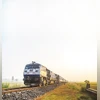 "Indian Railways needs consistent government support, according to officials")