


Congress flags security lapse; govt gets all-party backing on terror
Pahalgam attack: Political leaders expressed support for the government's stance on the Pahalgam terror attack at all-party meeting, but raised concerns over security lapses and preparedness
 "All-party meeting on Pahalgam")
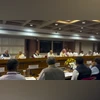
Defence Minister Rajnath Singh with Union Home Minister Amit Shah, EAM S Jaishankar, Finance Minister Nirmala Sitharaman, Minister, BJP National President JP Nadda and Congress President Mallikarjun Kharge in New Delhi. (Photo: PTI)
Listen to This Article
At an all-party meeting held on Thursday, the Bharatiya Janata Party-led central government provided details to leaders of various political parties about the April 22 terror strike in Pahalgam, Jammu and Kashmir, which claimed the lives of 26 people. Officials described the attack as an attempt “to vitiate the country’s atmosphere”.
The government said it received unanimous support from political parties in its stand against terrorism.
‘All parties united against terror’, says Rijiju
Union Minister Kiren Rijiju, speaking to the media after the meeting chaired by Defence Minister Rajnath Singh, said, “All parties said they were with the government and against terror.” Senior officials from the Intelligence Bureau and the Union home ministry were present to brief leaders on security steps being undertaken to prevent future attacks.
Leaders condemned terrorism and demanded decisive action against those responsible, including the terror camps. However, Opposition parties such as the Congress also raised questions over lapses in security.
Congress president Mallikarjun Kharge said his party had highlighted a “security lapse” during the discussions and assured full support for any action taken against the attackers. Leader of Opposition Rahul Gandhi said, “Everyone at the meeting unequivocally condemned the terror attack and offered full support to the government.”
Also Read

 "Pahalgam Security, Pahalgam, terrorist attack")
 "World Bank")
 "Jagdeep Dhankhar, Jagdeep, Dhankhar, VP")
 "Life Insurance Corporation")
 "Milind Deora, Milind, Deora")
Kharge also said it would have been appropriate for Prime Minister Narendra Modi to be present at the meeting to hear the views of the opposition first-hand.
We stand united as a nation & fight against terrorism. The All Party Meeting resolved to support the actions taken by the govt and appeal to everyone to maintain harmony amongst all communities. pic.twitter.com/9ICdzcIAaH
— Kiren Rijiju (@KirenRijiju) April 24, 2025
Pahalgam attack: India acts against Pakistan
Following the April 22 attack, the Centre implemented a series of stringent measures targeting Pakistan. Among the major actions were the suspension of the Indus Waters Treaty of 1960, effectively stopping the flow of water across the border, and the shutdown of the Integrated Check Post (ICP) at Attari, a significant land crossing point.
Further, India withdrew travel privileges previously extended under the SAARC Visa Exemption Scheme and invalidated existing visas issued to Pakistani citizens. Authorities also restricted access to Pakistan’s official X (formerly Twitter) handle within Indian territory and directed Pakistani nationals residing in India to exit the country within 48 hours.
Pakistan criticised India’s suspension of the water-sharing agreement, describing it as vital to the livelihood of 240 million people. In response, Islamabad terminated all trade with India and warned of possibly withdrawing from the 1971 Simla Agreement, which has long served as a foundational accord for peace and diplomacy between the two countries.
All-party meet: What was shared at the meeting
During the all-party briefing, the government assured political leaders that every necessary measure was being taken to enhance security and combat terrorism. It also emphasised that the attack occurred at a time when Jammu and Kashmir was witnessing economic growth and a boost in tourism.
While specific details about counter-terror plans were not disclosed, the Opposition did not demand them, sources said.
The meeting was initiated by Defence Minister Rajnath Singh, with Intelligence Bureau Director Tapan Deka presenting a 20-minute overview of the incident. He responded to questions from leaders, while Home Minister Amit Shah intervened where needed. Singh outlined how the attack unfolded and described the government’s immediate response.
Leaders from all parties reportedly pledged to support any measures the government takes in response to the attack, including actions targeting Pakistan.
Pahalgam terror attack: Security lapse
Following the meeting, sources told PTI that although security forces were present in Pahalgam, they had not been deployed in the specific area where tourists were headed, due to a lack of communication from local authorities.
According to the sources, tour operators and hotel owners had failed to inform authorities about the group’s travel plans to Baisaran. Force deployment, they clarified, depends on timely inputs from such operators.
Opposition flags concerns, backs action
While opposition members raised concerns over the handling of the incident, PTI reported that the discussion remained civil and there was no “bitter exchange”. Some opposition leaders questioned the delay in response and pointed out gaps in the security apparatus.
However, many MPs also acknowledged the evolving situation in Jammu and Kashmir, noting the absence of incidents such as stone-pelting or arson in recent times. Sources said there was a renewed interest among MPs in visiting the region, with several parliamentary panels having already made trips there.
[With PTI inputs]
More From This Section
 "tomatoes")
 "Asaduddin Owaisi, Asaduddin, Owaisi")
 "Congress, Congress flag")
 "All-party meeting on Pahalgam")
Topics : Kiren Rijiju Amit Shah Narendra Modi Rahul Gandhi Pahalgam attack BS Web Reports Congress BJP Kashmir Jammu and Kashmir Terror attack
Don't miss the most important news and views of the day. Get them on our Telegram channel
First Published: Apr 25 2025 | 2:21 PM IST