


China's weather ambitions aim to cut reliance on Europe's ERA5 climate data
Europe's ERA5 is considered the benchmark of climate data, providing details on a range of variables such as rainfall, temperature and wind, spanning more than eight decades
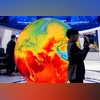 "An AI-powered meteorology warning booth at the Shanghai New Expo Center")
An AI-powered meteorology warning booth at the Shanghai New Expo Center | Photo: Bloomberg


Listen to This Article
By Mary Hui
China’s push to be a weather superpower has seen authorities accelerate efforts to end reliance on a European dataset, promoting a homegrown alternative for the era of artificial intelligence-fueled forecasting.
Europe’s ERA5 is considered the benchmark of climate data, providing details on a range of variables such as rainfall, temperature and wind, spanning more than eight decades. It has been the backbone of the AI revolution in weather forecasting so far, and some of the leading AI models in China, including from Huawei Technologies Co., are trained using the product.
But a reliance on a foreign resource runs counter to Beijing’s push for security and technological independence. China also sees meteorological data as a key pillar of its weather ambitions and recently intensified efforts to develop and share “high-value data.”
“Weather forecasting is national security,” said Andreas Prein, a professor at ETH Zurich and an expert in weather and climate modeling. “If you solely depend on external data sources, you make yourself vulnerable.”
Also Read

 "China Taiwan")
 "China EU flags")
 "Nvidia")
 "Arunachal CM Pema Khandu")
 "Visa Application")
ERA5 is a product of climate reanalysis — a complex process of crunching global weather observations to reconstruct a consistent picture of past conditions. It was developed by the European Centre for Medium-Range Weather Forecasts, with data extending from 1940 and continually updating.
That information is crucial for understanding trends and improving forecasts. Governments use ERA5 data to manage risks such as floods and wildfires, while insurers rely on it to develop catastrophe models. The European Union estimates its economic benefits at hundreds of millions of dollars annually.
Pivotal as ERA5 is, Beijing sees its outsize role as potentially risky. Part of its motivation for developing a domestically-built dataset is to “break China’s dependence on European and American reanalysis products,” according to a statement from the National Data Administration in September.
The same month, the China Meteorological Administration made an updated version of its global reanalysis — called CMA-RA V1.5 — available for download worldwide for the first time. The agency said earlier in the year that some Chinese AI models were already being trained using the data.
Hui Su, a professor of atmospheric sciences at the Hong Kong University of Science and Technology, is using the Chinese data at her weather tech startup Stellerus to train regional AI models and evaluate numerical models. One advantage is that it divides the world into smaller grids than ERA5, she said.
“This high spatial and temporal resolution gives you a lot of training data,” according to Su.
Beyond AI, utilizing the China-made product could help pave the way for a more sophisticated market around hedging against weather risks — an industry that’s more prominent in the US and Europe.
“If international markets can get their hands on more data from China, you would have many companies wanting to get involved” in designing and brokering weather contracts, said David Whitehead, head of weather risk management at Vaisala Oyj. He added that the Finland-listed company, which provides data that supports financial hedging, recently started studying potential uses of the Chinese reanalysis.
The CMA claims its reanalysis outperforms in relation to wind speeds at a height of 100 meters (328 feet) over China, the world’s biggest generator of wind power, but it’s unlikely to replace ERA5 soon. Technologically, the Chinese data is about 15 years behind, said Dick Dee, founder of Planet-A Consulting, who played a key role in developing ERA5 during his tenure at ECMWF.
Still, ERA5 has its own biases and shortcomings, according to Rémi Gandoin, product development manager at Danish engineering consultancy C2Wind. That means tapping multiple datasets will be helpful for scientists studying climate change and weather extremes, as well as renewable energy developers making engineering decisions on wind farm design.
“In the future, people will benefit from having not just one dataset, but several,” Gandoin said.
More From This Section
 "US President Donald Trump, Trump")
 "US President Donald Trump")
 "gaza")
 "Crash")
 "Federal agents detain a man after his court hearing in immigration court at the Ted Weiss Federal Building in New York City, on July 9")
Don't miss the most important news and views of the day. Get them on our Telegram channel
First Published: Dec 23 2025 | 8:57 AM IST