


Gaza peace deal brokered by Trump faces collapse as violence resumes
A good way to find the answer would be to look at what's probably also the best model for creating a peacekeeping force for Gaza: the Kosovo Force, better known as KFOR
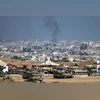 "Gaza, Gaza strike")
The simple cause of such rapid unraveling is that neither Hamas nor the Israeli government was happy with the agreement they were pressed into signing by Trump and leaders from the region | Photo: Bloomberg


Listen to This Article
By Marc Champion
Why does the 20-point peace deal US President Donald Trump brokered for Gaza, barely 10 days ago, already seem to be in trouble?
Instead of getting ready to disarm and retire from politics, Hamas militants have emerged from their hideouts to execute Palestinian rivals and reassert control in areas from which Israeli forces withdrew. Israel says the terrorist group is also ambushing its troops, while Hamas says the Israel Defence Forces continue bombing Gaza from the air. Both accusations look to be accurate, while the IDF is also refusing to reopen the Rafah crossing between Gaza and Egypt, as required.
The simple cause of such rapid unraveling is that neither Hamas nor the Israeli government was happy with the agreement they were pressed into signing by Trump and leaders from the region. But, given that both sides said from the start they had no intention of implementing key terms of the deal, “Why are they misbehaving?” is probably the wrong question. A better one would be: “How is it that they can get away with it?”
Also Read

 "Israel Flag, Israel")
 "israel, hostages, hamas, gaza, palestine")
 "prisoners, Gaza peace deal")
 "gaza, palestine")
 "Donald Trump, Trump")
A good way to find the answer would be to look at what’s probably also the best model for creating a peacekeeping force for Gaza: the Kosovo Force, better known as KFOR, which was formed in 1999 and continues to operate today.
It's no coincidence that the next-day structures laid out in Trump’s 20-point plan were based on a proposal from former UK Prime Minister Tony Blair. These in some aspects resemble the ones that he was involved in constructing for Kosovo, which in 1999 was a restive, Muslim-majority province within mainly Orthodox Christian Serbia.
Blair played a key role in the North Atlantic Treaty Organization’s military intervention that June to prevent Serbia’s Yugoslav National Army (JNA) from succeeding in the ethic cleansing of Kosovo. A JNA campaign of violence and terror that included civilian massacres had driven hundreds of thousands of Muslim Kosovars to flee the country. More relevant for Gaza’s case is what followed the 78-day bombing campaign that eventually persuaded Serbia’s president, Slobodan Milosevic, to withdraw his troops: The imposition of KFOR, together with a temporary United Nations-run civilian administration.
Critically, KFOR had a pre-life as a Nato “peace implementation force,” which began deploying to neighboring Macedonia as soon as the Kosovo air campaign began, in March 1999. The aim was to have peacekeepers ready to cross the border the moment a cease-fire deal was reached. But as the air campaign dragged on without apparent effect, Blair also became the leading advocate (to a more reluctant US President Bill Clinton) for putting Nato boots on the ground, not as peacekeepers but peacemakers. The force in Macedonia duly switched up to be ready for combat.
Nato tanks never did have to fight their way into Kosovo. Yet the preparation of a force that began months before a settlement meant it was ready. On June 12, 1999 — two days after Nato suspended its bombing sorties and the UN passed a resolution to authorize a non-UN peacekeeping force for Kosovo — troops from the newly named KFOR crossed the border. The first soldiers into the field were special forces, the very antithesis of UN Blue Helmets.
No two conflicts are, of course, the same. I’m not suggesting equivalence between either Milosevic and Israel’s Prime Minister Benjamin Netanyahu, the IDF and the JNA, or Hamas and the Kosovo Liberation Army (KLA). There are, however, numerous similarities between the conditions KFOR faced at the time and the mission now under discussion for Gaza.
Start with the scale and nature of the problem. In both cases, these are relatively small places and small populations (2 million for Gaza, 1.6 million for Kosovo), in which a conflict with a long history and deep ethno-religious roots gave rise to accusations of attempted ethnic cleansing, or worse. In both cases, it was clear the peace would be unstable. In Kosovo as in Gaza, it was evident the dominant force would return to occupy territory under the deal if it could, and that the insurgents expected to disarm would do so only if forced.
Even though the KLA’s 17,000 armed fighters saw Nato as being on their side, they were reluctant to hand over their arms. Weapons were still getting collected after the deadline for disarmament passed. Official KFOR claims of progress in the program were hotly disputed by Serbia and Russia. KLA revenge killings against ethnic Serbs seen as collaborators did take place. But you don’t have to deny those setbacks to recognize that the outcome would have been far worse had 50,000 KFOR troops not begun flooding into the security vacuum left behind by Serbian troops, even as they retreated.
This is the better answer to why Tump’s Gaza deal looks to be in trouble so soon: Its peacekeeping element remains on a drawing board in Cairo. It was not prepared in the run-up to a deal, because Trump wasted months toying with proposals to turn Gaza into a Mediterranean Atlantic City, emptied of Palestinians — an idea that was catnip to Israeli extremists and a non-starter for Arab leaders. The change to a more robust policy for pressuring both parties to halt the carnage came only in September, after Netanyahu embarrassed the US president by bombing Qatar.
KFOR was far from perfect. The fact that it remains necessary a quarter-century later, if in greatly reduced numbers, testifies to that. Yet this also remains one of the most successful peacekeeping operations on record and a useful model for whatever force gets assembled for Gaza. That, too, looks set to take the form of a UN-authorized, but not UN-led, peacekeeping force. It will reportedly be led by Egypt and comprise troops from Azerbaijan and Indonesia among other Muslim nations. This fulfils a KFOR lesson, which is that the composition should draw from countries those policed are likely to trust. Another is that it should be big enough and well-armed enough to succeed, with a clear mandate and robust rules of engagement.
Trump’s art of dealmaking doesn’t lend itself to the level of preparation that allowed KFOR to fill the security vacuum in Kosovo the moment it emerged. So that ship has sailed. That doesn’t mean his cease-fire has already failed. But as Egypt puts a force in place for Gaza, it should look to KFOR for its other lessons and focus on filling Gaza’s security vacuum as soon as possible — even if that now has to be done in salami slices. Rafah would be a good place to start.
(Disclaimer: This is a Bloomberg Opinion piece, and these are the personal opinions of the writer. They do not reflect the views of www.business-standard.com or the Business Standard newspaper)
More From This Section
 "Storm")
 "china, china flag, Politburo")
 "China Taiwan")
 "FBI, Federal Bureau of Investigation")
 "toxic airplane fumes, aircraft cabin air quality")
Topics : Donald Trump Gaza Gaza conflict israel Israel-Palestine Hamas
Don't miss the most important news and views of the day. Get them on our Telegram channel
First Published: Oct 20 2025 | 10:20 AM IST