


Global politics in 2025: Protests, peace deals and shifting alliances
Nepal's Gen-Z protests, a fragile Gaza ceasefire and Donald Trump's return reshaped global politics in 2025, as nations grappled with unrest, wars and shifting alliances
 "Nepal Protest")
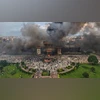
In September, Nepal witnessed one of its most intense uprisings in decades as Gen-Z protesters took to the streets over a social media ban and rising corruption. (Photo:PTI)
Listen to This Article
The global political landscape shifted sharply in 2025, with Donald Trump's return to the White House highlighting it. A peace deal briefly halted the Israel–Hamas war and Nepal was rocked by youth-led protests that toppled its government. Major powers edged toward trade wars as alliances realigned and new flashpoints emerged.
Here are the major events that shaped world politics in 2025.
Trump’s return and the tariff shock
Donald Trump returned to the White House on January 20 for his second term, repeating his signature “America First” message. In a few weeks, his administration announced a fresh round of tariffs on key trading partners, including Europe, China and India, arguing that unfair trade practices had hurt American workers.
On April 2, the administration unveiled its “Liberation Day” reciprocal tariffs. Implementation was pushed to August to allow countries time to negotiate interim deals. While several nations, including Malaysia and Bangladesh, reached agreements, India remains without a settlement.
The tariffs also triggered a sharp escalation between the US and China. Washington raised duties to 145 per cent, prompting Beijing to retaliate with tariffs of up to 125 per cent. Global markets were rattled. After weeks of tension, the two sides reached a truce on May 12, with the US cutting tariffs to 30 per cent and China lowering its rates to 10 per cent.
Also Read

 "US visa, US immigration, green card")
 "KP Sharma Oli, Oli, Nepal PM")
 "Wheels India")
 "Pollution, Gurugram Pollution")
 "Trade, tariffs")
Gaza ceasefire and Ukraine peace talks
In October, a breakthrough appeared in the Middle East. After two years of war, Israel and Hamas agreed to a ceasefire, mediated by the Trump administration. Under the deal, Hamas released all 20 living Israeli hostages in exchange for more than 1,900 Palestinian prisoners held by Israel.
The truce, however, has remained fragile. Al Jazeera reported more than 500 Israeli violations within two months, with at least 356 Palestinians killed since the agreement.
Washington also led a peace roadmap for the Russia–Ukraine war. In November, the US revealed all 28 points of its proposal, but the plan faced criticism for being overly favourable to Russia.
Nepal’s Gen-Z uprising
In September, Nepal witnessed one of its most intense uprisings in decades as Gen-Z protesters took to the streets over a social media ban and rising corruption. The demonstrations escalated after police used water cannons, tear gas and rubber bullets.
Protesters attacked government buildings, including parliament, and set fire to the ruling Nepali Congress party’s central office. Under mounting pressure, Prime Minister KP Sharma Oli resigned on September 9. Protest leaders nominated former chief justice Sushila Karki to head an interim government, citing her zero-tolerance stance on corruption.
Bangladesh tribunal verdict against Hasina
In November, Bangladesh’s International Crimes Tribunal sentenced former prime minister Sheikh Hasina to death after convicting her of crimes against humanity. Former home minister Asaduzzaman Khan Kamal also received a death sentence, while ex-police chief Chowdhury Abdullah Al-Mamun was sentenced to five years in prison.
Hasina rejected the verdict, calling it politically motivated and delivered by a “rigged tribunal".
China–Japan tensions over Taiwan
On October 21, Sanae Takaichi became Japan’s first woman prime minister. Her early remarks on Taiwan triggered a sharp reaction from Beijing. Takaichi warned that a Chinese attack on Taiwan could pose a “survival-threatening situation” for Japan, which China described as interference in its internal affairs.
The exchange marked a further deterioration in ties, with both sides engaging in increasingly sharp rhetoric.
Other developments that shaped the year
Beyond these headline events, protests swept parts of Europe, and political violence shook the United States. In Italy, thousands marched against what they described as “genocide in Gaza,” while nearly 600,000 people protested across France against proposed budget cuts.
In the US, conservative activist and Trump aide Charlie Kirk was assassinated in September during an event at Utah Valley University. His killing and the government’s response reignited debates over free speech and political violence.
More From This Section
 "Yoon Suk Yeol, Yoon Suk")
 "Singapore")
 "Volodymyr Zelenskyy, Zelenskyy")
 "Bondi beach shooting, Australia")
 "Taliban")
Topics : Politics Protest KP Sharma Oli Nepal tariffs Sheikh Hasina Bangladesh Trump inauguration BS Web Reports US China trade war Taiwan Japan Russia Ukraine Conflict israel Israel-Palestine
Don't miss the most important news and views of the day. Get them on our Telegram channel
First Published: Dec 15 2025 | 3:00 PM IST