


Israel-Iran war escalates; Iran's cluster bombs bring war to civilians
As the Israel-Iran war enters its eighth day, missile and drone strikes escalate tensions. While Trump weighs US military support, an Iranian cluster bomb injures dozens at an Israeli hospital
 "Soroka Hospital in Israel")
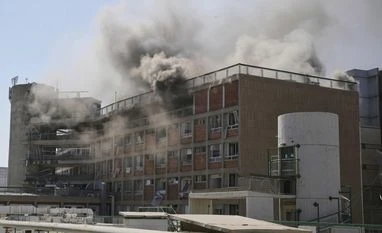
Smokes raises from a building of the Soroka hospital complex after it was hit by a missile fired from Iran in Be'er Sheva, Israel, Thursday, June 19, 2025 | Photo: PTI
Listen to This Article
As the Israel-Iran conflict enters its eighth day, tensions have reached a new high. Both countries unleashed waves of missile and drone attacks on Friday, marking the most intense exchange yet. Israel targeted key Iranian nuclear infrastructure, prompting a sharp retaliation from Tehran. In a major escalation, Iran fired missiles armed with cluster munitions — the first confirmed use of such weapons in the ongoing confrontation. One of these strikes hit an Israeli hospital, injuring dozens.
Following the hospital attack, Israeli Prime Minister Benjamin Netanyahu vowed that Iran’s leadership would pay a “full price”. He stated that Israel is “ahead of schedule” in its military campaign, having already surpassed initial expectations.
“We are moving faster than planned. Our goal is clear: to neutralise Iran’s nuclear capabilities before it is too late,” Netanyahu said.
Israel strikes deep into Iran
The Israel Defense Forces (IDF) continued their focused strikes on Iranian military and nuclear assets, including infrastructure linked to Tehran’s nuclear program. Notably, Israel claims it has the capability to target all of Iran’s nuclear facilities — even the heavily fortified Fordow site, built deep within the mountains.
While Iran insists its nuclear program is for peaceful purposes, Israeli officials maintain it is a direct threat to regional stability.
Also Read

 "Sensex, BSE, stock markets")
 "Donald Trump, Trump")
 "Strait of Hormuz")
 "Benjamin Netanyahu, Benjamin, Netanyahu, Israel PM")
 "trade, import, export, container, shipping")
IAEA confirms strikes on multiple nuclear sites
The International Atomic Energy Agency (IAEA) is closely tracking the fallout from Israeli airstrikes launched under “Operation Rising Lion” beginning June 13. Director General Rafael Grossi confirmed damage at nuclear facilities in Natanz, Esfahan, Arak, Tehran, and Khondab.
At Natanz, above-ground parts of the Pilot Fuel Enrichment Plant were destroyed, along with electrical systems critical to underground operations. “It was limited to this facility. There was no radiological impact externally,” Grossi said. However, contamination inside the facility was confirmed.
Esfahan’s site suffered hits to a uranium conversion plant and a reactor fuel manufacturing plant. The Tehran Research Center and TESA Karaj, both involved in centrifuge production, were also struck. At Khondab, a heavy water reactor under construction was damaged, though it held no nuclear material.
Grossi warned that the volume and dispersion of nuclear material across Iran leaves “potential for a radiological accident” very real. He added, “Military escalation threatens lives, increases the chance of a radiological release… and delays indispensable work towards a diplomatic solution.”
Despite a reduced IAEA presence due to security concerns, Grossi said inspections would resume once safe, and reaffirmed the agency’s readiness to send nuclear safety teams. “Amid these challenging and complex circumstances, it is crucial that the IAEA receives timely and regular technical information,” he said.
Tehran responds with cluster munitions
Iran responds with force, launching a barrage of drones and missiles at Israeli targets. The Israeli military confirmed that one of the missiles carried cluster munitions — marking the first documented use of such internationally controversial weapons in this conflict.
One of the most severe attacks hit a medical building in southern Israel, wounding 71 people. Most victims suffered minor injuries or panic-induced trauma while seeking shelter. The Israeli Health Ministry confirmed the toll, stating that emergency services remain on high alert.
Washington watches Israel-Iran conflict closely
As the crisis unfolds, the White House signalled growing concern. In a briefing on Friday, White House Press Secretary Karoline Leavitt said that US President Donald Trump would decide “within the next two weeks” whether to extend military backing to Israel.
“Based on the fact that there’s a substantial chance of negotiations that may or may not take place with Iran in the near future, I will make my decision whether or not to go within the next two weeks,” Leavitt quoted Trump as saying.
In a striking revelation, US intelligence now believes that Iran could produce a nuclear weapon in “a couple of weeks” if given the green light by Supreme Leader Ayatollah Ali Khamenei.
Behind closed doors, diplomatic conversations are underway. Trump’s special envoy Steve Witkoff has reportedly held multiple phone calls with Iranian Foreign Minister Abbas Araqchi, according to sources familiar with the matter.
Shake-up in Iran’s military leadership
Adding to the volatility, Iran has named Brigadier General Majid Khadami as the new head of intelligence at the Islamic Revolutionary Guards Corps (IRGC). The appointment comes after Israeli airstrikes killed his predecessor, Mohammed Kazemi, and two other senior officers — Hassan Mohaghegh and Mohsen Bagheri — last Sunday. The change in leadership signals a potential hardening of Iran’s military posture, as tensions rise.
US moves assets from Qatar base
Meanwhile, nearly 40 US military aircraft have vanished from the tarmac of a major American airbase in Qatar over the past two weeks. Military analysts suggest this could be a preemptive measure to shield US assets from potential Iranian retaliation, especially if the US becomes more directly involved in the conflict.
[With agency inputs]
More From This Section
 "Xi Jinping, Jinping, China President")
 "Workers at Felixstowe port recover a stolen Toyota RAV4 from a container")
 "China Taiwan")
 "cars, auto industry")
 "US army, US troops, National security guards")
Don't miss the most important news and views of the day. Get them on our Telegram channel
First Published: Jun 20 2025 | 12:03 PM IST