


What's fuelling the protests in LA as Trump cracks down on immigration
Protests erupt in Los Angeles over ICE raids and federal troop deployment without state consent, as the city becomes a flashpoint in Trump's aggressive immigration agenda
 "Los Angeles Protest, Protest")
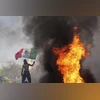
A protester waves a flag as a Waymo taxi burns near the Metropolitan Detention Center of downtown Los Angeles on Sunday following last night's immigration raid protest.(Photo: PTI)
Listen to This Article
Los Angeles has become the epicentre of nationwide outrage following a series of surprise raids by US Immigration and Customs Enforcement (ICE), part of President Donald Trump’s aggressive push to ramp up deportations. Over three days, thousands of protesters have taken to the streets, rallying against what they describe as a cruel and unconstitutional campaign targeting vulnerable communities.
The immediate spark was a coordinated ICE operation on Friday that led to 118 arrests in Los Angeles alone. Nationwide, the crackdown netted nearly 2,000 undocumented immigrants. The raids targeted workplaces suspected of hiring unauthorised labour using falsified documentation. The response in LA, however, was swift and defiant.
Demonstrators swarmed downtown and other parts of the city, blocking roads, ICE vehicles and entrances to federal detention sites. Clashes broke out between protesters and federal agents, who deployed tear gas and pepper balls after being pelted with projectiles. In Compton, a government vehicle was set ablaze, and fireworks were used to halt immigration vans in neighbouring Paramount.
National Guard sent in without governor’s approval
The protests intensified after Trump, invoking federal emergency powers, dispatched 2,000 National Guard troops to LA without California Governor Gavin Newsom’s consent. It marked the first unauthorised domestic troop deployment of its kind in 60 years.
Also Read

 "Donald Trump")
 "LA protest, LA protesters, Los Angeles")
 "Donald Trump,Trump")
 "Harvard, Harvard University")
 "Los Angeles Protest, Protest")
The White House justified the move as necessary to “restore law and order,” describing the protests as an “uprising” enabled by sanctuary policies. “A once great American City has been invaded and occupied by Illegal Aliens and Criminals,” Trump wrote on social media, doubling down on incendiary rhetoric.
Governor Newsom responded sharply, calling the deployment “acts of a dictator” and promising to challenge the move in court. “This is not about public safety—it’s about fear and control,” Newsom said on MSNBC, arguing that Trump had violated state sovereignty.
Democratic lawmakers across California echoed the concern. Senator Mike McGuire described the deployment as “fascist and un-American,” warning that militarising the situation would only deepen the crisis.
Roots of a long-simmering conflict
While the ICE raids triggered the current unrest, the protests are driven by broader grievances about immigration policy under Trump’s administration. Since beginning his second term, Trump has vowed to escalate deportations to record levels, setting a daily target of 3,000 arrests. So far, his administration has averaged 778 per day, according to data from the Transactional Records Access Clearinghouse (TRAC).
Central to the escalation is Section 287(g) of the Immigration and Nationality Act, which allows the federal government to deputise local law enforcement as immigration agents. Critics say this blurs the line between community policing and immigration control, eroding trust in police among migrant communities.
Los Angeles, a city with deep immigrant roots and a long history of resisting federal overreach, has been at the forefront of the so-called “sanctuary movement”. Its residents—many of them undocumented or from mixed-status families—see the raids not just as law enforcement but as targeted intimidation.
Racial tension, economic pressure and political stakes
The protests also tap into older currents of racial injustice and economic precarity. Many of those arrested were Latin American immigrants employed in informal or low-wage sectors. Advocacy groups argue that these workers are being scapegoated while their employers face little consequence.
The timing of the crackdown has raised eyebrows, coming amid a broader national debate over executive overreach and authoritarianism. Legal experts have drawn comparisons to the 1992 Rodney King riots, when the National Guard was last deployed in Los Angeles. The current moment, they say, similarly reflects a breakdown in federal-state cooperation and a crisis of legitimacy.
Legal battles and more protests
As lawsuits begin to mount and marches continue citywide, the future of Trump’s immigration agenda in California remains uncertain. Civil rights organisations have filed multiple challenges, arguing that the troop deployment violates both the Posse Comitatus Act and constitutional limits on federal authority.
Protesters, meanwhile, are pledging to remain in the streets. “We’re not going to be silenced,” said Maria Contreras, an organiser with LA United for Immigrant Justice. “This is our city. We’re not going anywhere.”
The unrest in Los Angeles has become a bellwether for the national mood, underscoring the deep divisions that define America’s immigration debate in 2025. As federal agents clash with state officials and communities take to the streets, LA is not just protesting—it’s warning.
More From This Section
 "Egypt's new administrative capital")
 "china Flag, China")
 "Explosion")
 "Harvey Weinstein")
 "Benjamin Netanyahu, Benjamin, Netanyahu, Israel PM")
Topics : Donald Trump immigration United States
Don't miss the most important news and views of the day. Get them on our Telegram channel
First Published: Jun 09 2025 | 3:40 PM IST